

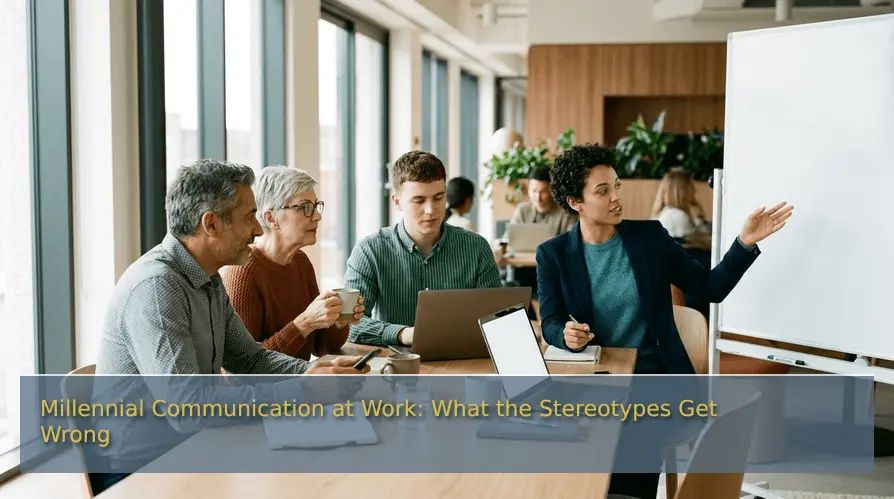
Millennial Communication at Work: What the Stereotypes Get Wrong: The stereotype says Millennials avoid real conversation in favor of screens. The evidence says their preferences are driven by context rather than by aversion. Messaging tools handle routine coordination, email carries formal and client-facing exchanges, and face-to-face remains the preferred channel for anything consequential: performance discussions, compensation, raising a serious concern, or resigning. Notably, one survey found older Millennials were the group least confident using the phone at work, less so than Gen Z, which suggests the generational assumptions here are pointed at the wrong people.
Key Takeaway
Millennials are not avoiding conversation, they are sorting it by consequence. Messaging handles routine coordination, email carries anything formal or client-facing, and face-to-face remains the preferred channel for anything that genuinely matters: performance, compensation, a serious concern, or a resignation. The stereotype about screen avoidance also points at the wrong cohort, since older Millennials report the lowest confidence using the phone at work, below Gen Z.
- A clear read on what channel choice does and does not tell you about someone’s engagement
- The data that overturns the most confidently held belief about generational phone habits
- A practical fix for channel sprawl, which costs far more than any channel preference does
Context governs the channel, and reading channel choice as a personality trait is where most of this goes wrong.
The Preference Is Contextual, Not Categorical
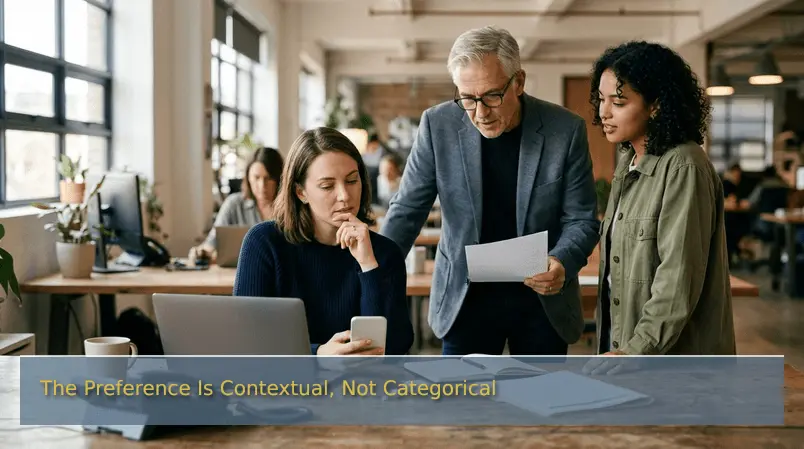
The millennial communication style is best described as channel-matching. Quick coordination goes to messaging tools. Anything formal, documented, or client-facing goes to email. Anything difficult, sensitive, or consequential goes to a live conversation.
That last category is the one the stereotype misses entirely. Research consistently shows a strong preference for in-person discussion when the stakes are meaningful, including performance reviews, compensation conversations, raising a significant issue with a manager, and resigning.
Broad channel data supports the same picture across the workforce: around 64% of employees prefer instant messaging, 63% still rely on email, and 54% continue to value in-person meetings. These are not competing camps. They are the same people choosing different tools for different jobs.
Summary: Millennials are not avoiding conversation, they are sorting communication by consequence.
The Phone Stereotype Points the Wrong Way
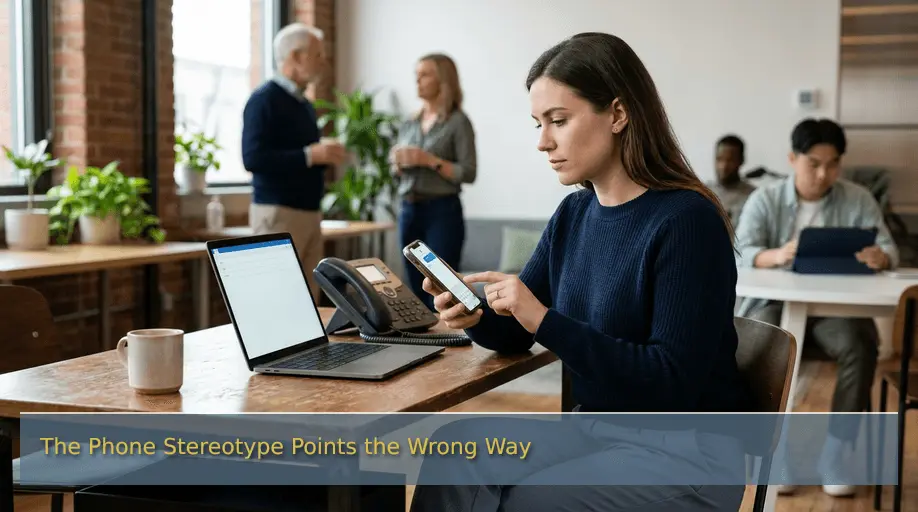
One of the most durable assumptions in this space is that younger generations fear the phone. It is widely believed: over 90% of surveyed workers agreed with the stereotype that Gen Z prefers messaging to calling, including three-quarters of Boomers.
The underlying data complicates it. In the same body of research, roughly 47% of Gen Z reported feeling confident using the phone at work, while older Millennials came in lowest at around 36%. If phone anxiety is a generational marker, it is not marking the generation everyone assumes.
This is a useful example of how a stereotype survives on repetition rather than evidence, and why checking the assumption is worth more than acting on the reputation.
Summary: The most confidently held belief about generational phone habits is aimed at the wrong cohort.
The Real Problem Is Channel Sprawl

Most communication friction now comes from having too many channels rather than from disagreement about which to use. When a decision might live in email, a chat thread, a project tool, or a meeting recording, nobody can reliably find it.
The cost is measurable. Miscommunication is estimated to cost Millennials around 5.6 hours a week and Gen Z around 4.6. Poor communication overall carries a per-employee annual cost that runs well into five figures.
The fix is norms rather than tools. Decide as a team which channel carries decisions, which carries urgent requests, and what response time each implies. Teams that write this down once spend markedly less time hunting for information later.
Summary: Agree on what each channel is for, because the ambiguity costs more than the channel choice ever does.
What This Means for Leaders
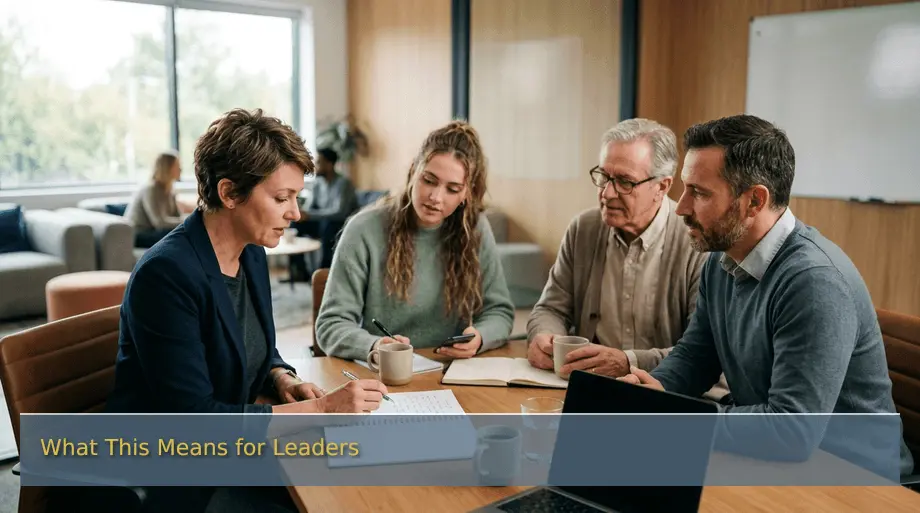
Let context drive the medium, and say so explicitly. Delivering difficult feedback over chat because it feels efficient reads as avoidance regardless of intent, and it is one of the faster ways to erode trust with this group.
The reverse matters too. Scheduling a meeting for something that could have been three sentences in writing signals that you do not value the time of people who are already spending over forty hours a week on communication.
The quality of leadership communication has measurable downstream effects. Around 79% of employees say it shapes how well they understand organizational goals, which in turn affects motivation and productivity. This is not a soft variable.
Summary: Match the channel to the stakes, name the norm, and most of the generational friction here disappears.
FAQs About Millennial Communication at Work
1. Do Millennials prefer email or instant messaging?
Both, for different purposes. Instant messaging handles internal coordination, quick questions, and informal exchange. Email remains the default for formal communication, client contact, and anything that needs a record. Broad workforce data shows preference figures for the two channels running close together, around 64% and 63% respectively, which reflects that most people use both routinely rather than choosing one. Framing it as a binary preference is what produces misleading conclusions about generational habits.
2. Is it true that Millennials avoid phone calls?
The stereotype is widely believed and poorly supported. In survey research, older Millennials actually reported the lowest confidence using the phone at work, below Gen Z. Even so, the more useful framing is not about fear but about expectation. An unscheduled call interrupts focused work and carries an implication of urgency, which is why many people across generations now prefer a brief message to arrange a call rather than receiving one unannounced.
3. How much time do employees spend on workplace communication?
More than most organizations account for. Millennials report spending roughly 43 hours per week on workplace communication, with Boomers closer to 30. Around 76% of professionals say they are communicating across more channels than they were the previous year. Those figures overlap heavily with time nominally allocated to actual work, which is a substantial part of why communication norms have shifted from a nice-to-have to a genuine productivity issue.
4. Does poor communication actually affect retention?
Substantially. Around 63% of employees who are considering leaving their jobs cite poor internal communication as a contributing factor. The mechanism is straightforward: unclear communication produces unclear expectations, unclear expectations produce a sense of being set up to fail, and that sense erodes commitment steadily. Because the cost appears as turnover months later rather than as an immediate complaint, communication quality is chronically underweighted relative to its actual effect.
5. How should teams decide which channel to use for what?
Write it down once, as a team, and keep it short. A workable version specifies where decisions are recorded, what counts as urgent and which channel carries it, expected response times per channel, and what always warrants a live conversation. The specific answers matter less than having agreed answers. Most channel friction comes from people operating on unstated and conflicting assumptions rather than from anyone having chosen wrongly.
