


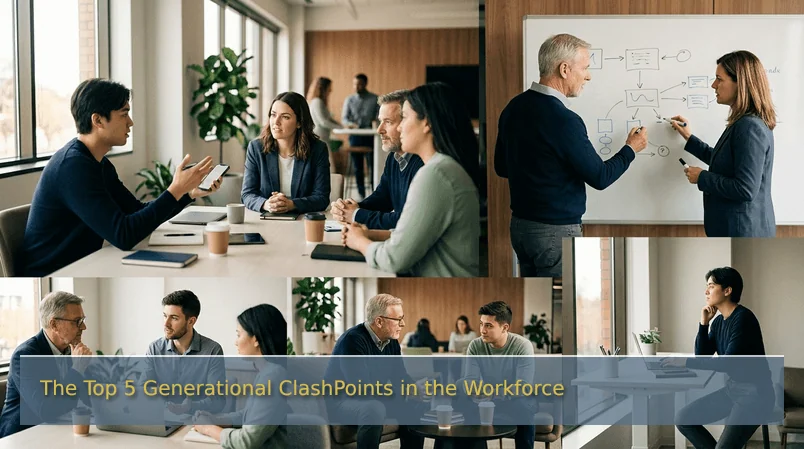
Top 5 Generational ClashPoints in the Workforce: The five friction points we see most often across client organizations are communication, work ethic, empowerment, motivation, and burnout. We call them ClashPoints, and the pattern underneath them is consistent: each generation holds a defensible position shaped by what it lived through, and the conflict comes from the assumption that everyone else is working from the same reference points. The fix is almost never deciding who is right. It is surfacing the reasoning on both sides, because most of these tensions dissolve the moment people understand why the other position exists.
Key Takeaway
Most workplace generational conflicts are not disagreements about goals. They are disagreements about method, mistaken for disagreements about commitment. A manager who reads a delayed email reply as disengagement, or a direct report who reads an unscheduled phone call as an ambush, is responding to a signal that meant something different to the person who sent it. Five friction points account for most of it.
- A name for each of the five friction points, from communication and work ethic through to burnout
- What each side is actually responding to, from channel norms and tenure patterns to recognition
- One concrete move per ClashPoint: channel norms, output measures, support levels, incentives, and recognition
Five ClashPoints, five legitimate perspectives, and no villains in any of them.
ClashPoint One: Communication

Communication is the friction point we hear about most. The disagreement is rarely about what needs to be said. It is about channel, expected response time, and how much warmth a message is supposed to carry.
Boomers and many Xers learned that important conversations happen live, so a phone call signals that something matters. Millennials and Gen Z largely learned that a call without warning signals that something has gone wrong, and that written communication is both more efficient and more respectful of focus. Neither reading is unreasonable. Both are wrong about the other person.
These generational differences in workplace communication compound quietly. A Boomer reads a slow reply as indifference. A Gen Zer reads an unannounced call as a problem. Neither says anything, and both adjust their opinion of the other.
Summary: Name your channel norms out loud, because the assumptions people bring are invisible until they collide. Naming the pattern instead of the person is where generational intelligence begins.
ClashPoint Two: Work Ethic

The oldest and least accurate version of this ClashPoint is that younger generations do not want to work. The research does not support it. Meta-analyses comparing work ethic across cohorts find far less variation than the conversation implies.
What has genuinely changed is how commitment gets displayed. Older definitions lean on visible presence and hours logged. Newer definitions lean on output and efficiency. Tenure patterns feed the misunderstanding: as of 2025, Gen Z averages roughly 1.1 years in early-career roles, against about 1.8 for Millennials, 2.8 for Gen X, and 2.9 for Boomers. That looks like restlessness from one side and like sensible career management from the other.
Job hoppers and job huggers are both responding rationally to the market they entered. The behavior differs. The underlying commitment mostly does not.
Summary: Measure the output you actually care about, or you will keep measuring visibility and calling it work ethic.
ClashPoint Three: Empowerment

What one person experiences as helpful guidance, another experiences as micromanagement, and the same manager behavior can produce both reactions on the same team in the same week.
Gen Z tends to want more context before starting: clear expectations, a defined path, and a check-in structure. That is not dependence. It reflects growing up with detailed rubrics and instant answers, and wanting to get it right the first time. Gen X, by contrast, developed strong self-reliance early and often reads frequent oversight as a signal of distrust rather than support.
The practical error is applying one setting to everyone. Ask people how they want to be supported, and most will tell you accurately. Of all the generational workplace conflicts we see, this is the one managers are least likely to hear about directly, because almost nobody raises it until they are already leaving.
Summary: Empowerment is not a fixed amount of freedom, it is the amount each person needs to do their best work.
ClashPoint Four: Motivation

Assumptions about what younger employees want are aging badly. As of 2026, only about 6% of Gen Z and Millennials say reaching a leadership position is their primary career goal, yet 76% of Gen Z and 67% of Millennials still want a senior role at some point. Ambition has not disappeared. It has become conditional on the job being sustainable.
The broader shift is from career acceleration toward career durability. Stability, skill-building, and well-being are increasingly weighted ahead of speed of advancement. A promotion that costs someone their health is now a trade many will decline, and declining it is not a lack of drive.
For Boomers, motivation still tracks closely with recognition and visible impact. Naming a contribution publicly does real work here, and it costs nothing.
Summary: Ask what someone is optimizing for before you design the incentive, because speed is no longer the default answer.
ClashPoint Five: Burnout

Burnout shows up across every generation, but the causes differ. Boomers more often report workload volume. Xers more often report stagnation. Millennials more often report work that feels disconnected from anything meaningful. Gen Z more often reports being overlooked for the work that would actually develop them.
One 2026 finding deserves attention: among Gen Z and Millennials, the second leading driver of burnout is not workload at all. It is not being recognized enough. That reframes the problem for a lot of leaders, because recognition is considerably cheaper to fix than capacity.
Gen Z workplace culture gets blamed for burnout conversations that were happening long before Gen Z arrived. What changed is willingness to name it.
Summary: Recognition is a burnout intervention, not a morale perk, and most organizations are underusing it.
FAQs About The Top 5 Generational ClashPoints in the Workforce
1. What exactly is a ClashPoint?
A ClashPoint is a recurring point of tension between generations at work where each side holds a position that is defensible given its formative experiences. The term is deliberately neutral. It does not assume one group is behaving badly and the other is correcting them. The value of naming these tensions is that it moves the conversation from character judgment toward reasoning, which is where solutions actually live. Most ClashPoints ease considerably once both parties can articulate why the other position exists.
2. Do generational differences in the workplace hold up to research?
Partially, and the nuance matters. Studies comparing traits like work ethic across cohorts often find smaller differences than popular commentary suggests, and some apparent gaps turn out to reflect life stage rather than generation. What does hold up is that shared formative experiences shape expectations, particularly around technology, communication norms, and institutional trust. The useful framing is not that generations are fundamentally different kinds of people. It is that they entered work under different conditions and calibrated their expectations accordingly. The evidence is strong enough to act on, which is why generational differences in the workplace training works from observed behaviour rather than personality labels.
3. How many generations are in the workforce right now?
Four are present in meaningful numbers as of 2026: Baby Boomers, Generation X, Millennials, and Generation Z. A small number of Silent Generation workers remain, and the oldest members of Generation Alpha are still several years from entry. Millennials are the largest single cohort at roughly 36% of the US labor force, followed by Gen X at about 31%, Gen Z at about 18%, and Boomers at about 15%. Gen Z passed Boomers in workforce share for the first time in 2023.
4. Which ClashPoint causes the most damage?
Communication generates the highest volume of friction, but empowerment tends to cause the most costly damage. Communication misfires are usually visible and correctable within a conversation or two. Empowerment mismatches accumulate silently: an employee who feels micromanaged or, conversely, abandoned rarely raises it directly, and the resulting disengagement often surfaces first as a resignation. Because the same management behavior produces opposite reactions across a team, this is also the ClashPoint most likely to blindside an otherwise capable leader.
5. Is reverse mentoring an effective way to address these tensions?
It works well when it is genuinely bidirectional and poorly when it is decorative. Pairing a younger employee with a senior leader to exchange perspective on technology, communication norms, or emerging expectations builds understanding in both directions and gives the junior participant visibility they would not otherwise get. The programs that fail are the ones framed as older employees needing remedial help, which insults one party and burdens the other. Structure it as mutual exchange with defined goals and it consistently outperforms one-off training. It works best inside a wider cross generational learning programme, where knowledge is expected to travel in both directions rather than down from the top.
