



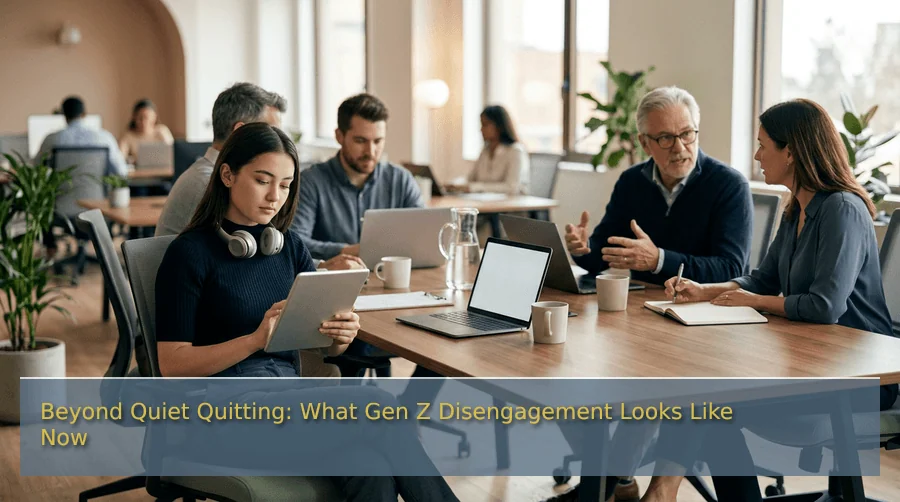
Beyond Quiet Quitting: What Gen Z Disengagement Looks Like Now: Quiet quitting was a 2022 story, and the conditions that produced it no longer exist. When the job market was hot, disengaged employees set boundaries and kept their options open. Now that hiring has slowed, they stay put and disengage internally instead. Researchers have started calling this quiet cracking, and it is harder to spot precisely because performance holds steady while motivation erodes underneath. If you are still watching for the signs of quiet quitting, you are looking for a pattern that has already been replaced by a quieter one.
Key Takeaway
Quiet quitting ended because the conditions that produced it ended. When leaving was easy, disengagement looked like boundary-setting with the exit door in view. Now that hiring has slowed, the same disengagement stays put and turns inward, a pattern researchers have started calling quiet cracking. Performance holds steady while motivation erodes underneath, which means the dashboards stay green right up until the resignation arrives.
- Why quiet quitting was a response to market conditions rather than a generational trait
- The two patterns that replaced it, and why low turnover may be measuring caution instead of commitment
- The specific signals to watch, given that output is the last thing to fall
Same underlying problem, quieter presentation, and a great deal harder to see coming.
What Quiet Quitting Actually Was

Quiet quitting was never about quitting. It described doing the job as defined and declining the unpaid extras beyond it, which is a boundary rather than a betrayal. The framing at the time cast it as laziness, and that reading missed what was happening.
It emerged in a specific set of conditions: abundant job openings, rising wages, and a widespread sense that going above and beyond had not paid off during the previous decade. When leaving is easy, disengagement expresses itself as detachment with the exit door in view.
Those conditions have reversed. Job openings have fallen, quit rates have dropped well below their 2022 peak, and wage growth for people who stay has caught up with wage growth for people who move. The calculus changed.
Summary: Quiet quitting was a rational response to a labor market that no longer exists.
What Replaced It: Quiet Cracking and Job Hugging

Quiet cracking describes a gradual erosion of motivation and connection that happens while performance holds steady. Research on the pattern found roughly 20% of employees experiencing it frequently and another 34% occasionally. Unlike quiet quitting, it is not a decision. It is what happens when someone stays in a role they have outgrown because leaving feels too risky.
The companion trend is job hugging: staying put out of caution rather than commitment. Estimates put nearly 45% of full-time US workers in this position as of 2026, which is a substantial share of workforces that look stable on paper.
We use the terms job hoppers and job huggers to describe these two orientations, and the important point is that neither is a character trait. Both are reasonable responses to the market conditions in front of someone.
Summary: Low turnover is not the same as high engagement, and in this market the two are frequently mistaken for each other.
The Gen Z Read

Gen Z absorbed most of the blame for quiet quitting, and much of it was misplaced. When the trend was at its peak, a significant portion of what looked like withdrawal was energy redirected into second jobs and side income during a period of high inflation.
The Gen Z workplace mindset is best understood as pragmatic rather than disengaged. This generation entered work watching Millennials demonstrate loyalty through a recession without much return on it, and drew a reasonable conclusion about where to place their bets.
Gen Z career expectations have shifted accordingly. As of 2026, only about 6% of Gen Z name reaching leadership as their primary goal, while 76% still want a senior role eventually. They want the destination. They are declining the version of the journey that costs their health to complete.
Summary: Gen Z is not checked out, they are unwilling to spend themselves on terms they consider unreasonable.
What Leaders Should Actually Watch For

The signals for quiet cracking differ from the ones most managers were trained to notice. Output stays consistent, so performance dashboards will not surface it. What changes is discretionary contribution: fewer questions in meetings, less initiative on anything unassigned, a narrowing of scope that nobody announces.
The drivers are consistent across the research. Unclear expectations, workloads that expanded without acknowledgment, absent recognition, and no visible path forward. Notably, insufficient recognition ranks as the second leading contributor to burnout among Gen Z and Millennials, ahead of many workload factors.
The intervention is unglamorous. Ask directly, listen to the answer, and act on at least one thing you hear. People who have been quietly cracking usually know exactly what is wrong and have simply stopped expecting anyone to ask.
Summary: Watch discretionary effort rather than output, because output is the last thing to fall.
FAQs About Beyond Quiet Quitting: What Gen Z Disengagement Looks Like Now
1. What is the difference between quiet quitting and quiet cracking?
Quiet quitting is intentional and boundary-based: an employee decides to do their defined role and no more, usually to protect work-life balance. Quiet cracking is unintentional and erosive: motivation and emotional connection decline gradually while the employee continues trying to perform. The practical difference matters for managers. Quiet quitting is visible because scope narrows deliberately. Quiet cracking hides behind steady output and polite professionalism, which is why it often surfaces first as an unexpected resignation.
2. How engaged are employees right now?
US engagement sat at roughly 31% in 2025, down from a peak near 36% in 2020 and declining steadily since. Globally, the figure is lower, at about 20% in 2025. Both measures come from long-running research using consistent methodology, so the trend line is reliable even where the absolute numbers surprise people. The decline is widely attributed to sustained workplace disruption, thinner management layers, and reduced clarity about expectations and direction.
3. Is job hugging bad for organizations?
It is risky in a way that is easy to miss. Low voluntary turnover looks like a healthy retention metric, but when it reflects caution rather than commitment, an organization accumulates people who have emotionally checked out while remaining on payroll. The exposure comes later. When hiring conditions improve, job huggers become movers quickly and often in clusters, which turns a stable-looking workforce into a sudden retention problem with very little warning.
4. Do side hustles indicate a disengaged employee?
Usually not. Second income streams among younger workers correlate more closely with cost of living pressure than with dissatisfaction, and cost of living is the largest concern Gen Z and Millennials report as of 2026. Some side work also reflects skill-building or creative interest that has no bearing on primary employment. The signal worth attention is not whether someone has additional income. It is whether their engagement at work has changed, which is a separate question.
5. What is the single most effective response to this kind of disengagement?
Consistent, specific recognition combined with clear expectations. Both are low cost and both address named drivers directly. Recognition works because insufficient acknowledgment is a leading contributor to burnout, and clarity works because unclear expectations rank near the top of every study on the subject. Neither requires budget approval or organizational restructuring, which is fortunate, since the interventions that do require those things generally take longer than the retention window allows.
