
Gen Alpha at Work: What Leaders Should Prepare For Before the First Wave Arrives: Gen Alpha, born 2010-2024, is the first generation to grow up with touchscreens and AI chatbots as part of childhood. The oldest turn 16 in 2026, so they are taking their first part-time jobs now and will enter full-time roles around 2028-2032. We’re still learning about this generation, so treat any patterns you see as possibilities to explore rather than settled facts.
But their formative conditions are clear, and organizations that adjust onboarding, management, and AI norms now will stay ahead of the curve.
Key Takeaway
Gen Alpha will not arrive immediately. They will show up first as part-time hires and customers before becoming entry-level employees. Screens from infancy, disrupted schooling, and instant AI answers point to likely expectations around speed, feedback, and how work gets done.
- Who Gen Alpha are and why their formative years matter more than their age
- What their childhood suggests about their expectations at work, framed as hypotheses
- When they arrive and how to prepare onboarding, managers, and AI norms now
The best time to get ready for a new generation is before its first day.
Who Gen Alpha Are and Why Formative Years Matter
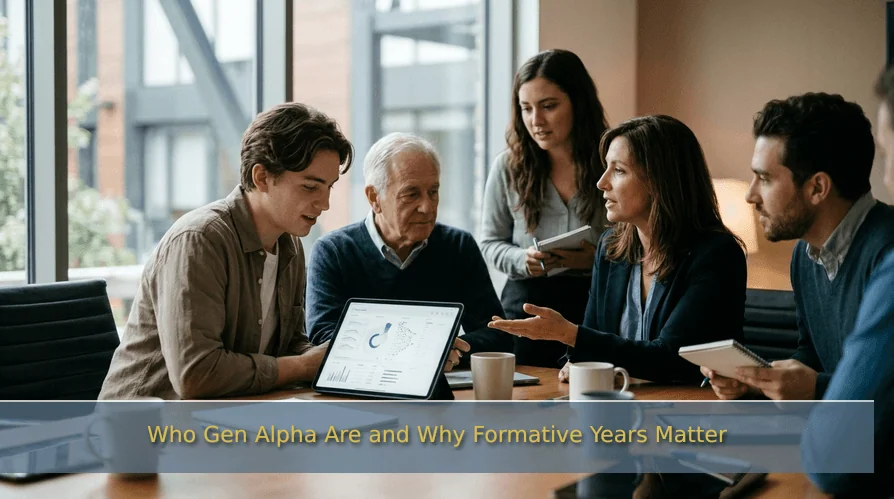
Born between 2010 and 2024, Gen Alpha is the first generation born entirely in the 21st century. Social researcher Mark McCrindle, who coined the name, has estimated that more than 2.5 million are born globally each week and that the cohort will number almost 2 billion.
The first members were born the same year the iPad launched. McCrindle calls them part of an “unintentional global experiment,” with screens used from infancy to soothe, entertain, distract, and teach.
Their school years were heavily impacted by the pandemic. According to the National Assessment Governing Board, 2024 national NAEP scores were below 2019 levels in every grade and subject tested, and those fourth and eighth graders were Gen Alpha. Expect uneven foundational skills alongside unusual comfort with self-directed, online learning.
As with every generation, the “why” is molded from each person’s formative conditions.
Summary: Gen Alpha’s defining conditions are screens from birth, disrupted schooling, and AI in childhood, with those conditions shaping what they expect at work.
What Gen Alpha’s Childhood Suggests About Their Work Expectations
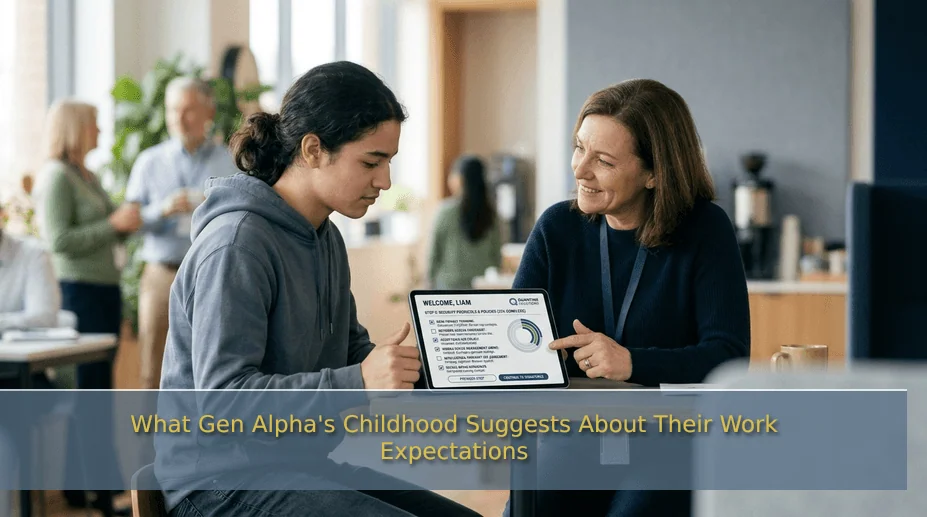
AI is already part of how this cohort learns. In a fall 2025 Pew Research Center survey, 64% of US teens ages 13-17 said they use AI chatbots, and about three in ten have them as part of their daily life. More than half (54%) have used chatbots for help with schoolwork. Teens were also more hopeful than worried. 36% expect AI to have a positive effect on their own lives over the next 20 years, compared with 15% who expect negative consequences.
From those conditions, we see three early hypotheses for leaders to test:
- Knowledge Sharing: Gen Alpha may expect answers on demand. A process that lives in one long-tenured person’s head will feel broken to them.
- Feedback: Raised on apps responding in seconds, they may read a quarterly review as silence. Short, frequent check-ins will likely matter more than formal reviews.
- Trust: Pew found about half of teens think AI would do a worse job than humans at making hiring decisions. They may use AI constantly but still want people, not systems, making the calls that affect them.
Many will also arrive fluent in tools but weaker social skills and unstructured problem solving. Be mindful of the existing skills gap.
Summary: Expect Gen Alpha to bring AI fluency and high expectations for speed, and to need deliberate support on interpersonal and professional norms.
When Gen Alpha Arrives and What Changes First
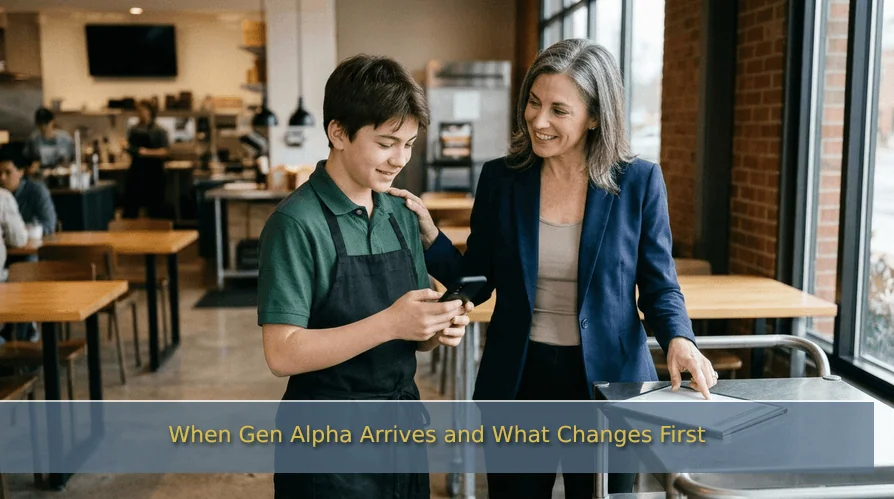
Gen Alpha already has a foot in the door. Those born in 2010 turn 16 in 2026, the age most US teens receive their first taste of employment. The Bureau of Labor Statistics reports that 36.5% of teens ages 16-19 were employed in July 2026, compared with 67.5% of young adults ages 20-24. So retail, food service, recreation, and seasonal roles will welcome Gen Alpha.
Full-time entry follows, around 2028 for high school graduates and 2032 for college graduates. They will join a workforce where AI is already routine. Deloitte’s 2026 survey found that 74% of Gen Z and Millennials use AI in their daily work, up from 57% and 56% in its previous survey.
What changes first is the gap between the independent processes a new hire used to complete tasks vs. how your team does them. Clunky systems, backlogged approval systems, and unwritten rules will be evident.
This also widens the span of generations at work. Gen Alpha will sit on teams with Baby Boomers who are staying in the workforce longer, which makes Communication and Mentorship ClashPoints a higher probability.
Summary: Gen Alpha reaches part-time work now and full-time roles around 2028-2032, so the time to prepare is during the current Gen Z hiring cycle.
How to Prepare Now
Rebuild Onboarding for Clarity
Onboarding is already a weak spot. Gallup found only 12% of employees strongly agree their organization does a great job onboarding new hires. For Gen Alpha, put the unwritten rules on paper. How to ask for help, when to call instead of message, and what “professional” means here are all ideal starting points. Pair every new hire with a buddy for the first 90 days.
Equip Managers for Shorter Feedback Loops
Managers will carry most of the adjustment. Train them to give brief, frequent feedback and coach interpersonal skills directly, without assuming those skills arrived with the hire. The habits that work for early-career Gen Z today, clear expectations and regular check-ins, are the right base for Gen Alpha.
Set AI Norms Before They Set Their Own
Gen Alpha will bring AI habits from school. Decide now which tools are approved, what data stays out of them, and when work must be a person’s own judgment. Explain the reasoning, not just the rule. Then invite your youngest employees to show colleagues what they know, a simple form of reverse mentoring that builds Trust across generations.
Summary: Clear onboarding, coached managers, and explicit AI norms will serve Gen Z today and Gen Alpha tomorrow.
FAQs About Gen Alpha at Work
1. What years define Gen Alpha?
We define Gen Alpha as people born from 2010 through 2024, directly after Gen Z (1997-2012), with a short overlap at the boundary. The oldest turn 16 in 2026 and the youngest are toddlers. That wide range means the youngest may grow up with very different technology than the oldest. Expect the picture to sharpen as the generation ages.
2. When will Gen Alpha enter the workforce?
They are now entering part-time and seasonal jobs, since the oldest turned 16 in 2026. Full-time hiring starts around 2028 for those who go straight to work and around 2032 for college graduates, with internships a little earlier. Most organizations will meet them first as customers and summer hires. A generational keynote speaker can help your leaders see what is coming before it shows up in exit interviews.
3. How is Gen Alpha different from Gen Z?
Gen Z were raised on smartphones and social media. Gen Alpha grew up with those already in place, plus voice assistants and AI chatbots. Many also did their earliest schooling during the pandemic. That suggests Gen Alpha may be more comfortable with AI and less practiced at live interaction. For the generation right before them, start with who Gen Z are at work and how a Gen Z keynote speaker frames them for leaders.
4. Should we change our AI policies because of Gen Alpha?
Set clear AI norms now, and Gen Alpha is one more reason. Pew’s research shows most teens already use chatbots, so new hires will arrive with habits formed in school. If your guidance is vague, they will write their own rules. Define approved tools, data limits, and where human judgment is required, then explain why.
5. What should HR do first to prepare?
Start with onboarding, because that is where expectations meet reality. Audit your first 90 days for unwritten rules, slow processes, and gaps in feedback. Our guide to revamping onboarding for the next generation is a practical starting point. Then train managers on frequent feedback and on coaching professional norms directly. Multigenerational HR training gives HR teams a shared framework for doing this across every generation.
