

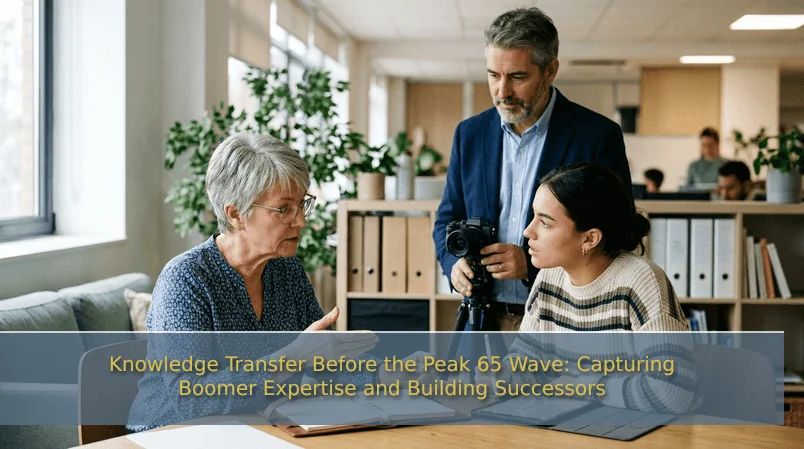
Knowledge Transfer Before the Peak 65 Wave: the window to capture what your most experienced people know is open now, and it closes one retirement at a time. According to the Alliance for Lifetime Income, more than 4.1 million Americans will turn 65 yearly from 2024 to 2027. Much of what they know is not in any manual. The answer is to treat knowledge transfer as a legacy role for Boomers while positioning as a growth path for successors, the heart of cross generational management.
Key Takeaway
Knowledge loss is not a retirement problem, but rather, appears from poor planning. Boomers built careers where expertise was a competitive edge, meaning handing it over comes across as replaceable. Reframe this ask as a promotion to coach, and pair it with a path for the people who inherit the work.
- Why Peak 65 makes knowledge transfer urgent, and what the data says about Boomers working longer
- What Boomers know that is not written down, and why some hold it close
- How to make knowledge transfer a legacy role and build successors who stay
Capture the knowledge while its owners are still in the room.
Why the Peak 65 Wave Makes This Urgent

Peak 65 is designed to be a four-year stretch. Most people turning 65 are Baby Boomers (born 1946-1964). A birthday is not a resignation, but each one brings a timing decision closer.
Many will keep working. The Bureau of Labor Statistics reports that 19.1% of Americans 65 and older were in the labor force in 2025, slightly below the 2019 peak of 20.2%. BLS projects participation for ages 65-74 will rise from 26.7% to 29.1% by 2035. That is a longer runway, but one uncontrollable.
The pipeline behind them is narrower. Gen X (born 1965-1980) is a smaller generation, and younger workers change employers more readily. That leaves fewer ready successors for each departing expert.
Summary: Peak 65 is not one wave of exits; it is a steady loss of expertise you cannot schedule.
What Boomers Know That Is Not Written Down
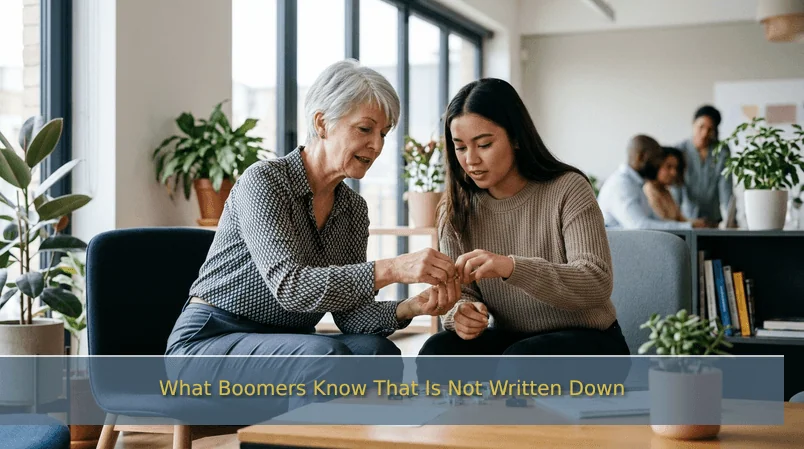
Your senior people’s most valuable knowledge is rarely in a system. It is the client who needs a call before a price change, the machine that drifts in cold weather, or the regulator who likes an early draft. Boomers’ judgment stems from decades and several recessions.
Many are slow to share it, and the reason is formative. Boomers entered a crowded job market in the 1970s and 1980s, when expertise you held closely protected your promotion. That is the Knowledge Sharing ClashPoint. Millennials and Gen-Z were raised in a world of open communication, whereas Boomers learned to treat it as earned capital.
Timing adds a layer. Someone planning to keep working may hear a request to document everything as a hint that you are planning their exit.
Younger employees sense the risk. In Deloitte’s 2026 Gen Z and Millennial Survey, only 54% of Gen Z and 60% of Millennials said their team could maintain performance if a key expert left tomorrow. They named limited incentives, time constraints, confidentiality concerns, and turnover as barriers.
Summary: Tacit knowledge goes unshared when the conversation feels like a threat. Here, the crucial part is changing how the ask feels.
Making Knowledge Transfer a Legacy Role, Not an Exit Task
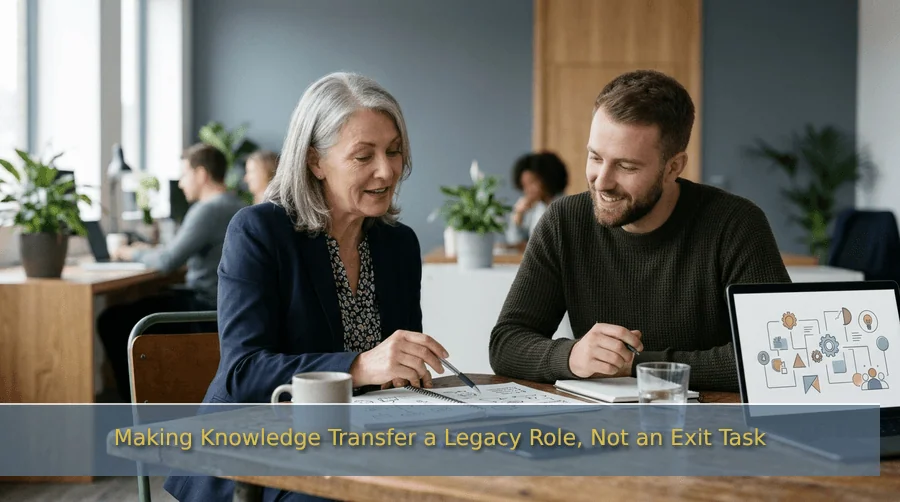
Align knowledge transfer with the competitive instincts that made those guard their expertise. Do not present it as a step toward retirement. Position it as a step up from practitioner to coach or expert to legacy builder. Back that with a title, time on the calendar, and visible recognition.
It also does not mean handing over the keys to the castle. Focus on curated guidance. The decisions new people get wrong, the relationships that matter most, the signs a project is drifting. Less data dump, more coaching.
Keep it conversational and two-way, with room for reverse mentoring so their pupils share tools and ideas in return. Mentoring itself is now standard. MentorcliQ reports that 98% of US Fortune 500 companies offered mentoring programs in 2024. The best programs are the ones where both sides learn.
Offer more than one format. Some do better with one-on-one mentoring. Others prefer recorded walkthroughs, a shared knowledge hub, or phased retirement that tapers hours while they train a successor.
Summary: Frame knowledge transfer as a promotion to coach, keep it two-way, and let each expert choose the format that fits.
Building Millennial and Gen X Successors
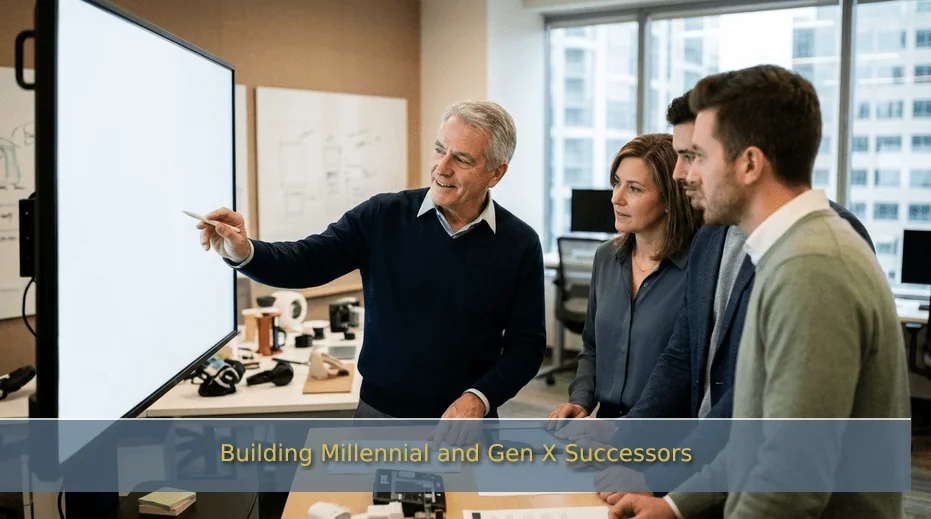
Transfer only works if someone is ready to receive it. Ask your retiring experts what made them successful: the habits, judgment calls, and relationships that mattered most. Use the answers to sharpen job descriptions, interview questions, and development plans.
Gen X is your natural bridge. Many Xers sit below retiring Boomers and understand both the history and the newer ways of working. Maintain a formal role in the handoff.
Millennials (born 1981-1996) came of age amid rapid change and expect steady growth. A 2018 Visier study found that these managers without a promotion in the prior two years resigned at a rate 5.2 points above average, while recently promoted ones resigned 3.1 points below. You cannot promote everyone, but making growth visible through Boomer-guided projects and clear succession paths helps buck the trend.
Ambition is conditional. Deloitte’s 2026 survey found only 6% of Gen Z and Millennials call leadership their primary career goal, yet 76% of Gen Z and 67% of Millennials want a senior role eventually. Stress and burnout were the top barrier for about half of both. Successors step up when the path looks sustainable.
Summary: Build successors by learning from your experts, using Gen X as the bridge, and giving younger talent visible, sustainable growth.
FAQs About Knowledge Transfer Before the Peak 65 Wave
1. What is Peak 65?
Peak 65 is the Alliance for Lifetime Income’s name for 2024 through 2027, when more than 4.1 million Americans turn 65 each year. Most are Baby Boomers. Turning 65 does not mean retiring, but expedites that decision for millions of experienced workers. The risk is a steady, hard-to-predict loss of expertise, which is why knowledge transfer is a core part of cross-generational management.
2. How many Baby Boomers are still working past 65?
BLS reports that 19.1% of Americans 65 and older were in the labor force in 2025, down slightly from 20.2% in 2019. It projects participation among people 65-74 will reach 29.1% by 2035. Survey estimates of how many Boomers plan to work past 65 vary widely, so labor force data is the steadier guide. Expect many experts to stay longer, on their own schedule, and plan the handoff sooner.
3. Why are some Boomers reluctant to share what they know?
Most Boomers started their careers when expertise protected your position. That made Knowledge Sharing a ClashPoint, as younger colleagues expect information to be open by default. A request to document everything can also sound like an exit plan. The answer is reframing the work as a respected coaching role, as we describe in what’s next for Boomers.
4. What role should Gen X play in succession?
Gen X often holds the roles directly below retiring Boomers, which makes Xers the natural bridge between institutional history and newer ways of working. Create a formal part in the handoff, such as co-owning the mentoring plan. Their independence is an asset, so give them ownership rather than a script. Read more about Gen X leadership.
5. How do we structure a knowledge transfer program that works?
Start with your most at-risk roles and pair each expert with a ready successor for regular, conversational sessions. Build in time for younger employees to share tools in return, through a reverse mentoring program or structured cross-generational learning. Offer several formats, from mentoring to recorded walkthroughs. Measure success by what successors can do alone, not documents produced. A leading multigenerational teams workshop helps managers run it.
