
AI Adoption Across Generations: Closing the Gap Between Frontier Users and Holdouts: Millennials lead AI adoption at work, Gen X and Gen Z follow, with Boomers rounding it out as the smallest share of advanced users. But the gap is not fixed on age. What matters most is the technology each generation helps advance, how much room people feel they have to experiment, and whether their managers support them. Teams close gaps fastest by pairing digital fluency with the judgment experienced employees bring.
Key Takeaway
AI adoption is uneven across generations, and the difference is apparent among power users. Treating holdouts as resistant misses the point. Many experienced employees are cautious for good reasons, and AI output needs the quality control and context they provide. Two-way learning works better than pushing tools harder.
- Where each generation stands on AI at work, based on 2025-2026 research
- Why formative experience with technology, not age, drives the gap
- How paired learning, reverse mentoring, and clear norms close it
Every generation has something AI-assisted work needs.
Where Each Generation Stands on AI at Work
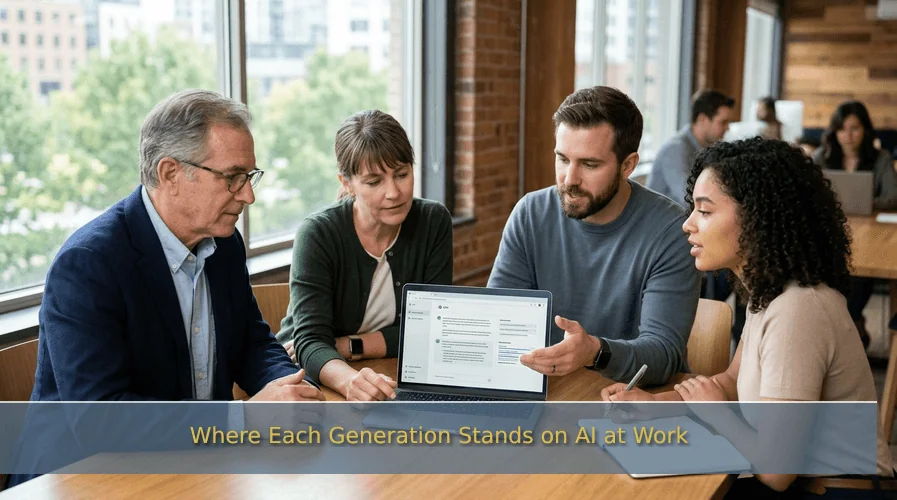
Using AI has become second nature to younger workers. According to Deloitte’s 2026 Gen Z and Millennial Survey, 74% of both groups use AI in their day-to-day work, up from 57% of Gen Z and 56% of Millennials a year earlier. The wider US workforce is further behind. Gallup reported that as of May 2026, 15% of employees use AI daily and 30% use it a few times a week or more.
The sharpest difference sits at the top. Microsoft’s 2026 Work Trend Index surveyed 20,000 knowledge workers who use AI and identified “Frontier Professionals” who hand complex, multi-step work to AI agents and redesign workflows around them. Of that group, 50% are Millennials (born 1981-1996), 23% Gen X (1965-1980), 22% Gen Z (1997-2012), and 4% Baby Boomers (1946-1964).
Millennials leading Gen Z may surprise you. They pair digital comfort with experience and authority to change how their own work gets done. Pew Research Center found in 2025 that 23% of workers ages 18-29 used AI chatbots at work at least a few times a month, versus 17% or less in older groups.
Readiness lags use. Deloitte found that 30% of Gen Z and 31% of Millennials believe their organization is not prepared for the changes AI will bring. Gallup found only 25% of US employees say their organization has communicated a clear AI plan.
Summary: Most workers now touch AI, but advanced use is concentrated, and organizations have not yet given people a clear path to it.
Why the Gap Is About Formative Experience, Not Age
Each generation learned technology under different conditions. Boomers viewed computers as workplace tools that had manuals for operating. Gen X learned by trial and error, often alone. Millennials grew up alongside the internet and adopted new platforms quickly. Gen Z never knew a world without instant answers. Those experiences shape the approach for how people approach a new tool.
The reasons people give for not using AI supports this. In Gallup’s February 2026 survey of more than 23,000 US workers, non-users most often cited preferring current ways of working (46%), privacy and security concerns (43%), ethical opposition (43%), and doubt that AI can help with their work (39%). Those are judgments about risk, not skill gaps.
Upbringings play a larger role than ever. Gallup found that 78% of employees who strongly agree their manager supports AI use are frequent users, compared with 44% of those who do not. When people have permission and a reason to experiment, they do.
Treat generational patterns as starting hypotheses. A cautious Boomer and Gen Zer will hold back for different reasons, with both understandable.
Summary: Holdouts are usually responding to their context and their concerns, not to their birth year.
What Each Generation Brings to AI-Assisted Work
AI produces drafts fast. Someone still has to decide whether they are right. Microsoft found that AI users rank quality control of AI output (50%) and critical thinking (46%) as the most important human skills in an AI-heavy workplace, and 86% treat AI output as a starting point, not a final answer.
That is where experienced employees earn their place. Boomers and Gen X carry years of domain knowledge and pattern recognition. They know which answer is technically correct but politically wrong, and which shortcut caused trouble last time. AI cannot supply that context.
Younger employees bring speed and range. Millennials are often the bridge. They are fluent enough to build new workflows, senior enough to put them in place. Gen Z experiments quickly and finds uses no one planned. Deloitte found that 79% of Gen Z and Millennials already use AI to find learning and development opportunities.
Notice how the most advanced users operate. Microsoft found that 43% of Frontier Professionals deliberately do some work without AI to keep their skills sharp, versus 30% of other professionals. Knowing when not to use the tool is the kind of judgment experience builds.
Summary: The best AI-assisted work pairs fast experimentation with seasoned judgment, and no single generation holds both.
How to Close the Gap
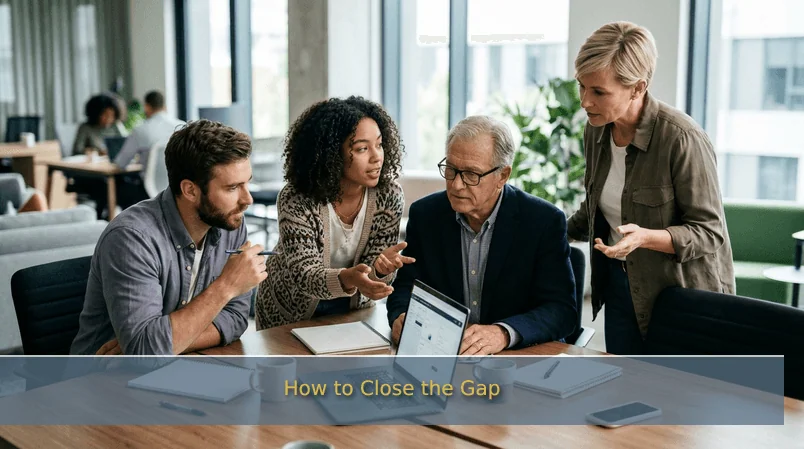
Pair People on Real Work
Put a frequent AI user and a domain expert on the same live task. One drives the tool while the other checks the output against what they know. Both learn faster than in a classroom, as Knowledge Sharing becomes an advantage instead of a ClashPoint.
Make Mentoring Two-Way
Reverse mentoring works when it is reciprocal. A younger employee teaches prompting and workflows; an experienced colleague educates how to judge the result and read stakeholders. Deloitte found that only 54% of Gen Z and 60% of Millennials believe their team could keep performing if a key expert left tomorrow, so knowledge flowing up matters as much as skills flowing down.
Set Norms Out Loud
Agree as a team on when AI is expected, when it is off limits, and who reviews AI-assisted work before it ships. Clear rules ease the risk concerns that keep many holdouts on the sidelines. Then make manager support visible, since Gallup’s data ties it closely to use.
Summary: Close the gap with paired learning, two-way mentoring, and explicit norms, not by pushing tools harder.
FAQs About AI Adoption Across Generations
1. Which generation uses AI the most at work?
Millennials lead among the most advanced users, making up half of the Frontier Professionals in Microsoft’s 2026 Work Trend Index. Gen X and Gen Z hold roughly equal shares behind them, and Boomers hold 4%. Everyday use is significant among younger workers too. Deloitte reports 74% daily use among Gen Z and Millennials. Treat these as patterns to test with your own people, which is where generational consulting can help.
2. Are older workers resistant to AI?
Not as a rule, and the label backfires. Gallup’s 2026 research shows people avoid AI mainly over current habits, privacy and security, ethics, and doubts about fit. Those concerns are reasonable and addressable. Experienced employees also provide the judgment needed to catch flawed AI output. Their caution is done as a quality check.
3. Why don’t Gen Z workers lead AI adoption if they are digital natives?
Growing up with technology builds comfort, not authority. Advanced AI use often means redesigning workflows, which takes experience and permission. Millennials tend to possess both. Gen Z adoption is rising fast, and many will become power users as they gain responsibility. The next cohort, previewed in Gen Alpha at work, will arrive with AI as a given.
4. How does reverse mentoring help with AI adoption?
It makes learning a two-way exchange instead of a lecture. A younger colleague shares tools and shortcuts while their experienced counterpart shares context and judgment. Both gain skills and status, so the arrangement never feels remedial. It also protects knowledge that might leave with a retiring expert. A structured approach to cross-generational learning keeps those pairs focused.
5. Where should leaders start?
Ask your team how they use AI now and what makes them nervous. Expect a mix of enthusiasm and concern in every generation. From there, set a few shared norms, pair people on a real project, and make your support visible. Mentorship and Trust are the ClashPoints most likely to surface, so review the top generational ClashPoints first. To build skills at scale, explore training different generations in the workplace.
