
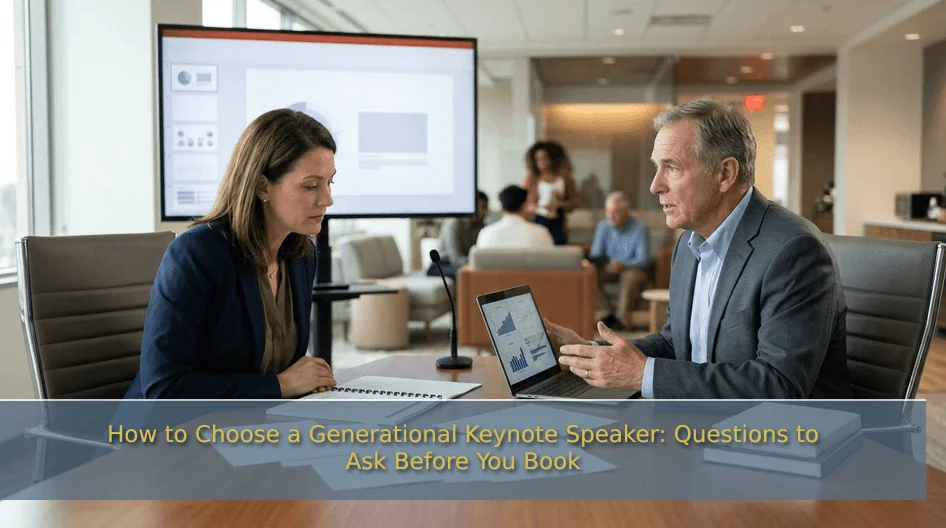
How to Choose a Generational Keynote Speaker: Questions to Ask Before You Book: the right speaker provides your audience with a shared language for each other, instilling unity. Look for research behind the content, an explanation of why each generation sees work the way it does, and takeaways people can use the next morning. Ask how the session will be customized to your industry and audience. Then plan what happens after the applause, because a keynote is a starting point, not the whole program.
Key Takeaway
A generational keynote is only as impactful as the research and preparation behind it. The best sessions explain formative years instead of repeating stereotypes, speak to all generations in the room, and leave audience members with something practical. A few direct questions before you sign will tell you which speakers can deliver that.
- What a standout generational keynote should do for your audience
- The questions to ask a speaker before you book, and the red flags to watch for
- How to extend the keynote into workshops and follow-on learning
Book for the conversation the session starts, not just the hour on stage.
What a Generational Keynote Should Do for Your Audience
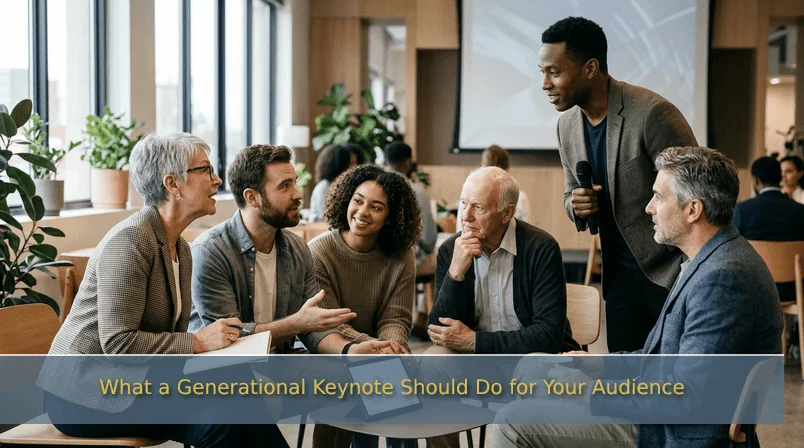
Your audience likely spans four or five generations: Baby Boomers (1946-1964), Gen X (1965-1980), Millennials (1981-1996), Gen Z (1997-2012), and a few members of the Silent Generation (1925-1945). Each group formed its expectations about communication, feedback, and loyalty under different conditions. Exceptional keynote names those conditions so people stop judging behavior and start understanding it.
That “why” is the difference between insight and entertainment. A speaker who says Gen Z prefers text is describing a pattern. The person who explains how growing up with constant connectivity shaped that preference gives the room a reason to be curious instead of annoyed. Traits should be presented as starting hypotheses rather than generalizations.
The session should also feel like it was built for your people. Industry examples, the generational mix of your audience, and the challenges leaders raised in planning should all show up on stage. Finally, every attendee should walk away with at least one thing to try. Team norms to set or a question to ask a colleague are great starts.
The stakes are real. Gallup reports that only 29% of US employees were engaged as of August 2026, and that managers account for at least 70% of the variance in team engagement. A keynote that helps managers read their teams better is aimed at that gap.
Summary: A strong generational keynote explains the formative-years “why,” fits your audience, and ends with practical next steps.
Questions to Ask Before You Book
Use these questions on your first call. Strong speakers welcome them.
- Where does your content come from? Look for ongoing research on the subject. BridgeWorks, for example, has studied generational behavior at work since 1998.
- How do you explain generational differences? The answer should center on formative experiences, notably tech, economy, or workplace norms.
- How will you customize this for us? Ask what they need from you in advance, like audience makeup, industry, current challenges, and event goals.
- How do you engage a mixed audience? Inquire about polling, audience participation, and storytelling, and how the format changes for 50 people versus thousands.
- What will attendees take back to work? Pick examples of concrete tools or frameworks, such as ClashPoints, the recurring friction points around Communication, Feedback, Work Ethic, and Trust.
- Can you deliver in our format? Confirm in-person, virtual, or hybrid delivery, and how engagement holds up in each.
- What happens after the keynote? Learn whether the content can extend into workshops, manager training, or onboarding.
Summary: Ask about research, customization, engagement, and follow-through before you compare dates or logistics.
Red Flags to Watch For
The most significant red flag is stereotyping. If the promotional clips play one generation for laughs, expect the same on stage, alongside part of your audience to tune out. Credible speakers treat every generation’s position as defensible.
Watch for a session that leans on one generation alone. Talks designed for only Gen-Z interests can leave Boomers and Xers feeling blamed and younger staff feeling studied. In this scenario, a focused session should help the whole room understand each other.
Be cautious about generic content. If a speaker cannot tell you what they will change for your industry or audience, you are buying a recording delivered live. The same goes for motivation without method as energy fades quickly when there is nothing specific to apply.
Finally, notice how the speaker handles evidence. Bold claims with no source, outdated birth years, or certainty about what “all Millennials” want suggest the content has not kept pace with the research.
Summary: Skip speakers who stereotype, generalize, or inspire without giving people anything to use.
Making the Keynote Last Beyond the Event
The best keynotes keep working after the event. People repeat a phrase, reference a story, and carry new language into meetings. You can make that more likely with a little planning.
Before the event, share the main themes with managers so they can open the conversation afterward. During the event, capture the polling results and questions. They show which ClashPoints matter most to your people. After the event, send a short recap with one action for each team to try.
Then decide what comes next. Many organizations follow a keynote with smaller sessions that turn awareness into skills, including a leadership workshop, manager training, or a team session on collaboration. Ask your speaker whether they can design that sequence with you.
Summary: Plan the follow-up before the keynote so the shared language turns into changed behavior.
FAQs About How to Choose a Generational Keynote Speaker
1. What does a generational keynote speaker actually cover?
A generational keynote explains how the events, technologies, and economic conditions of each generation’s formative years shape expectations at work. It focuses on the friction points teams feel most, like communication, feedback, and trust. The goal is to move the audience from judgment to curiosity. Impactful sessions also give people practical tools they can use right away. You can see how BridgeWorks approaches this on our generational keynote speaker page.
2. How far in advance should I start talking to speakers?
Start once your event date and audience are set, because customization takes conversation. A speaker needs time to learn your industry, audience mix, and the challenges these leaders want addressed. Targeted planning is what separates a tailored keynote from a generic one. Availability also varies by speaker and season. Reach out early and ask what the planning process looks like from first call to delivery.
3. Should I book a Gen Z speaker or a broader generational speaker?
It varies on what your audience is struggling with. If managers are mostly asking how to lead and retain younger employees, a Gen Z focus may fit best, and you can book a Gen Z speaker for that need. If the friction runs across several generations, a broader generational speaker is usually the better choice. Either way, the session should help the whole room understand each other. Avoid any talk that leaves one group feeling like the problem.
4. Does a generational keynote work for a large conference audience?
Yes, if the format is built for it. Interactive elements, including real-time polling and audience participation, keep energy up whether there are 50 people or several thousand in the room. Popular events also tend to mix executives, managers, and frontline leaders, so examples need to land at every level. Ask how the speaker adapts for association and industry events. Our Gen Z conference speaker sessions are designed for exactly that setting.
5. How do we build on a keynote after the event?
Treat the keynote as the opening of a longer conversation. Use the polling data and audience questions to see which ClashPoints matter most, then choose follow-on sessions that build skills in those areas. Many organizations add leadership workshops, manager training, or onboarding content that uses the same shared language. Our guide to the top generational ClashPoints is a useful follow-up read for attendees. Explore our full range of speaking and keynotes to plan the sequence.
