
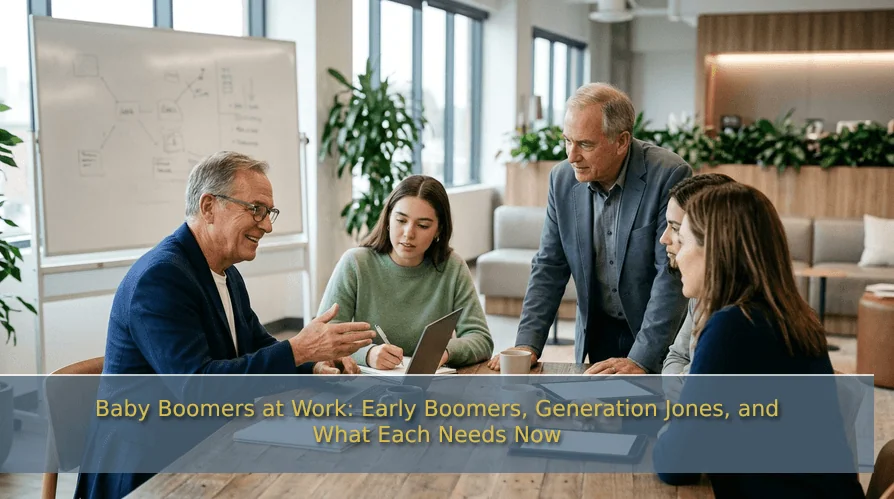

Baby Boomers at Work: Early Boomers, Generation Jones, and What Each Needs Now: Boomers (born 1946-1964, about 62 to 80 in 2026) are two generations sharing one label. Early members came of age in the optimism and activism of the 1960s. Generation Jones came of age in the 1970s, when jobs, gas, and even classroom desks were scarce. Those formative years still shape how each version leads, competes, and decides how long to keep working. Knowing which Boomer you are talking to makes your management more precise.
Key Takeaway
Boomers are not winding down as a group. Many are still working and leading, and their choices about stepping back shape your succession plans. Treating 19 birth years as one mindset misses significant differences between the 1960s and 1970s cohorts. The practical move is to understand both, then ask individuals what they want next.
- Why the Boomer generation splits into two subgroups
- What shaped Early Boomers and Generation Jones, and how it shows up at work
- What Boomers need from employers now, from flexible paths to knowledge sharing
Two Boomer generations, one shared label, and very different starting points.
Two Boomer Generations, Not One
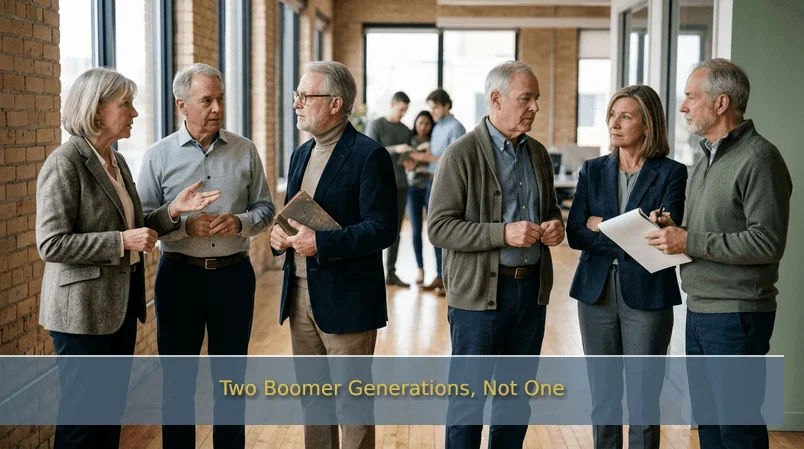
When we speak to audiences, Boomers often find us afterward to say, “I’m not like those earlier Boomers.” They are right. The label covers 19 birth years, and the world shifted in that timeframe.
The generation’s size is part of its story. According to Pew Research Center, the Boomer population peaked at 78.8 million in 1999. That size meant influence, alongside crowded, entry-level jobs, and promotion races.
We split Boomers into two subgroups. Early Boomers (born 1946-1954) who were teens in the 1960s, during a bull market and a wave of social movements. Generation Jones (born 1955-1964) who were teens in the 1970s, during stagflation, an oil embargo, and rising unemployment. Same generation, different formative conditions.
Treat these profiles as starting hypotheses. Many individuals sit between the two.
Summary: Boomers share a label and a demographic boom, but the 1960s and 1970s gave them two different starting points.
Early Boomers: Optimism, Activism, and Competition for Room at the Top
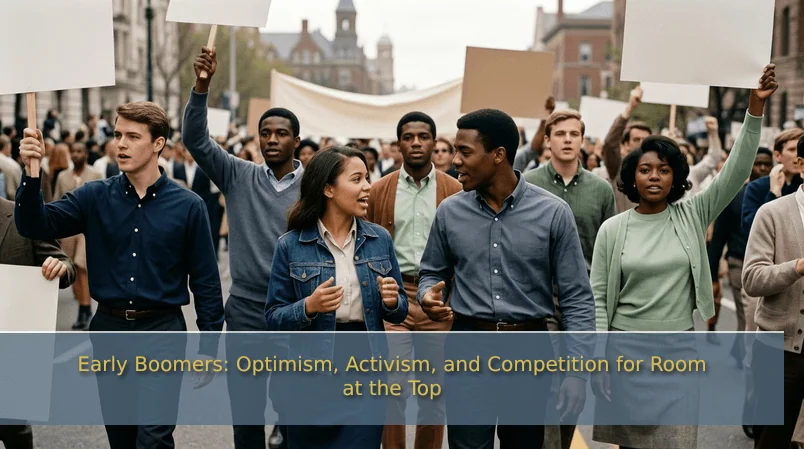
Early Boomers grew up watching the world change and believing it was possible to continue building upon. They followed, and sometimes argued with, leaders like Martin Luther King Jr., Gloria Steinem, and John F. Kennedy. The Vietnam War and its draft pushed young people to challenge political decisions in public. Sprinkle in the civil rights, women’s rights, and gay rights movements, and you get a cohort of born activists.
They also started careers in a growing economy. Seeing change happen, then experiencing career growth, left many with an optimistic, idealistic outlook. Key events: Woodstock, Vietnam, civil rights, women’s rights, and the Moon landing.
At work, that history appears as confidence in dreaming big and a strong sense of mission. It also pops up as competition. A massive cohort entered the workforce at once, so standing out mattered. Polish, presence, and a bolstered network became tools for getting noticed and moving up.
Today many Early Boomers want to stay active, keep learning, and choose how they contribute.
Summary: Early Boomers were shaped by a decade of change they helped create, which left them optimistic, mission-driven, and used to competing for room at the top.
Generation Jones: Shaped by the 1970s Squeeze
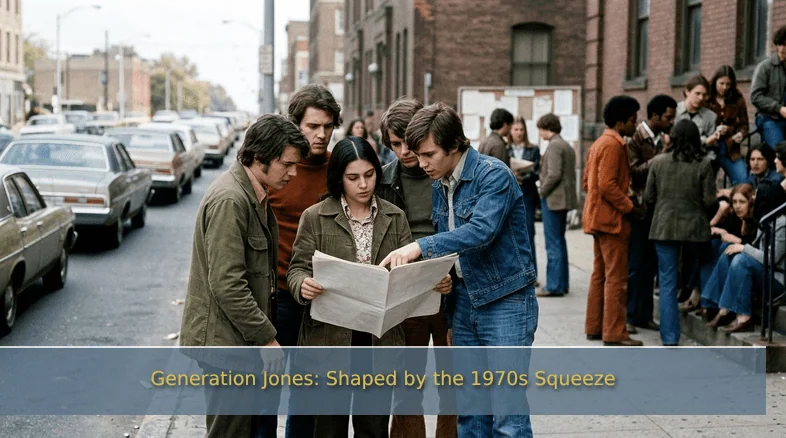
Generation Jones was too young for Woodstock or the “I Have a Dream” speech. By their teens, the counterculture had won many of its fights, and older activists were now chasing career growth. Gen Jones came of age in the backlash: Watergate, stagflation, the oil embargo, the Iran hostage crisis, and deindustrialization.
Scarcity was the theme. Schools did not have enough desks or books for the boom. Gas lines formed during the embargo. More households needed two working parents, divorce rates rose, and teens spent more time on their own. That independence foreshadowed Gen X.
The workplace lesson was simple. Nothing would be handed to you. With too few jobs, Jonesers learned to work hard, dress for the job they wanted, and stand out. Often the goal was staying employed. The name reflects that drive, “jonesin'” for more and keeping up with the Joneses.
At work, many Jonesers bring a stalwart Work Ethic, pragmatic view of Loyalty, and preference for earning Trust through results. Many are more skeptical of big promises than Early Boomers.
Summary: Generation Jones was shaped by scarcity and competition, which made many of them pragmatic, self-reliant, and fiercely hardworking.
What Boomers Need From Employers Now

Boomers are staying in the workforce longer than many plans assume. According to the Bureau of Labor Statistics, 19.1% of Americans 65 and older were in the labor force in 2025. BLS projections for 2025-2035 show the labor force age 75 and older growing 68%, and participation for ages 65-74 rising from 26.7% to 29.1%.
At the same time, the Alliance for Lifetime Income reports that more than 4.1 million Americans turn 65 each year from 2024 through 2027, a stretch it calls Peak 65. Some will leave, many will want a different arrangement, and both affect your bench strength.
What helps most:
- Flexible paths, not a cliff. Offer reduced hours, project roles, or advisory seats so people can step back without stepping out.
- Real Knowledge Sharing. Build two-way mentoring for Boomer expertise to reach younger colleagues and new tools reach Boomers.
- Respect for experience in Feedback. Many Boomers value specific, professional feedback tied to impact, not assumptions that they resist change.
- Different conversations for each subgroup. Early Boomers may respond to mission and legacy. Jonesers may respond to clear expectations and fair recognition.
Summary: Boomers are working longer and on their own terms, so give them flexible paths and a real role in passing on what they know.
FAQs About Baby Boomers at Work: Early Boomers, Generation Jones, and What Each Needs Now
1. What years define the Baby Boomer generation?
We define Baby Boomers as those born from 1946 to 1964. In 2026 that puts them at about 62 to 80 years old. Within that span, we use two subgroups: Early Boomers, born 1946-1954, and Generation Jones, born 1955-1964. The split follows formative years, not age. If you want the whole organization to share this vocabulary, a generations in the workplace speaker is a fast way to start.
2. What is Generation Jones?
Generation Jones is the later wave of Boomers, born 1955-1964, who matured in the 1970s. They grew up with stagflation, gas lines, and crowded schools. That scarcity taught many of them to compete hard and rely on themselves. The name stems from “jonesin'” for more and keeping up with the Joneses. Many Jonesers share traits with the Gen X colleagues who followed them.
3. Are Boomers still a big part of the workforce?
Yes, and the share of older workers is set to grow. BLS reports that 19.1% of Americans 65 and older were in the labor force in 2025. Its projections show the 75-and-older labor force growing 68% by 2035. Many teams will include Boomers alongside Gen Z for years. For a closer look at how Boomers are reshaping later careers, read what’s next for Boomers.
4. How should managers adapt to Early Boomers versus Generation Jones?
Start loosely with curiosity front and center. Early Boomers often respond to purpose, legacy, and the chance to shape big goals. Jonesers do well with clear expectations, fair recognition, and being trusted to deliver without hand-holding. Both groups tend to value professional, direct communication. Our guide to building trust with Baby Boomers and Generation X covers the Trust ClashPoint, and training in cross generational management helps managers practice these conversations.
5. How do we keep Boomer knowledge from walking out the door?
Plan for it before Peak 65 decides for you. Identify the hardest-to-replace experts and pair them with successors now. Make mentoring two-way for Boomers to gain new skills while sharing what they know. Offer phased roles so experts can keep contributing as they step back. Our article on knowledge transfer with Baby Boomers goes deeper, and cross generational learning programs give that exchange structure.
