
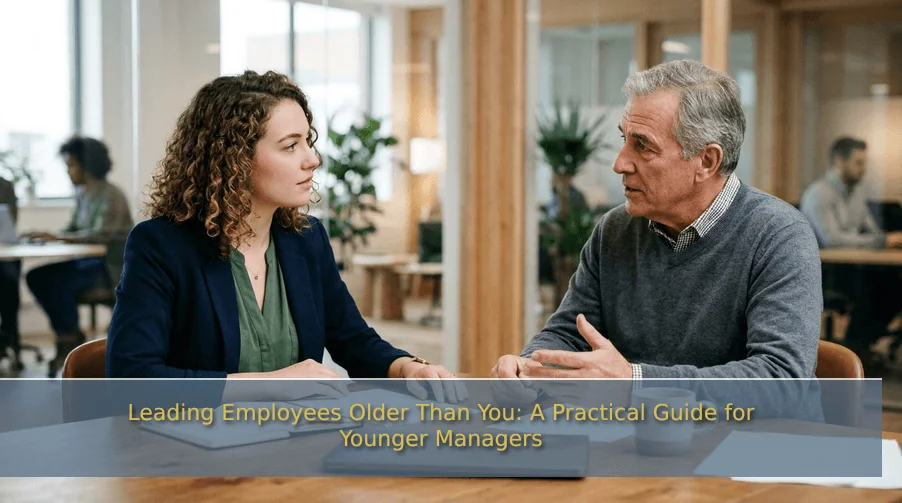
Leading Employees Older Than You: A Practical Guide for Younger Managers: you earn credibility with older team members by respecting and appreciating their knowledge and wisdom. Lead with questions, make your intentions visible before acting, and use their experience in real decisions. Hold the line on outcomes while staying flexible on methods. Most of the tension comes from different formative-year assumptions about authority, not from age itself.
Key Takeaway
Managing people older than you is now the norm when being a manager. The friction transpired in the first few weeks, when a well-meaning younger leader acts before older colleagues understand why. Credibility comes from consistency, transparency, and visible respect for experience, built one interaction at a time.
- Why younger managers leading older teams is now the norm
- What Boomer and Gen X team members watch for in a new, younger boss
- Five moves that build credibility fast, and how to handle open conflict
Authority comes with the title. Credibility you build yourself.
Why This Is Now the Normal Manager Experience
The manager’s chair has changed hands. Glassdoor’s 2025 midyear Worklife Trends report found that Millennials (born 1981-1996) passed Gen X as the largest share of US managers in 2025, as Fortune reported that July. By April 2025, Gen Z (born 1997-2012) held 10% of manager roles for the first time, according to Glassdoor.
Meanwhile, many Baby Boomers (1946-1964) and Gen Xers (1965-1980) remain in individual contributor roles. The result is a steady supply of new managers leading people who have more years in the field than they do.
The stakes are real. Gallup’s 2026 State of the Global Workplace report found manager engagement fell to 22% in 2025, down from 27% the year before. Gallup also finds that managers account for at least 70% of the variance in team engagement. A new manager who stumbles with experienced staff can pull a whole team down.
Summary: Leading people older than you is now a standard management skill, and it deserves deliberate training.
What Older Team Members Are Watching For
One of our colleagues learned this the hard way. Before joining BridgeWorks, she was a Millennial school administrator leading a staff that spanned four generations. In her first week, she dropped into classrooms unannounced, notepad in hand, to show teachers she had their backs. A Millennial teacher invited her to join a class game. The Gen X teacher pulled her aside and asked why she had come without warning. By the end of the day, her supervisor and the union president had both called, and one teacher was in tears, afraid she was being formally observed.
Her intentions were supportive. The method sent the opposite signal. In a hierarchical setting, an unannounced visit from a new boss reads as evaluation, not help.
That story captures what experienced employees tend to watch for in a younger manager:
- Respect for process. Do you understand how things work here before you change them?
- Transparency. Do you explain why, or just announce what?
- Use of their expertise. Do you ask what they know, or treat their experience as baggage?
- Consistency. Do your words match your actions from week to week?
Boomers and many Xers built careers where credibility was earned over time and authority followed a clear structure. Those are the Trust and Organizational Structure ClashPoints at work. They are starting hypotheses, not rules, but they explain a lot of first-month friction.
Summary: Older team members judge a new manager less on age than on whether that manager respects process, explains decisions, and values experience.
Five Moves That Build Credibility Fast

Credibility is built in small, repeated moments. These five moves work across most teams.
- Listen before you change anything. Hold one-on-ones in your first 30 days and learn with each person what does and doesn’t work along with things they wish leadership understood.
- Announce your intentions. Tell people what you plan to do and why before you do it. A short heads-up would have saved the school administrator a stressful first week.
- Put their experience to work. Ask senior team members to lead a project, coach a newer colleague, or pressure-test a plan. Using their knowledge shows respect more clearly than praising it.
- Ask how each person wants to be managed. Some want frequent check-ins. Others want autonomy and a clear deadline. Ask directly instead of applying your own preferences.
- Be steady on outcomes, flexible on methods. Define the results you need, then let experienced people choose how to get there.
Notice what is missing: proving you are the smartest person in the room. Authority you perform tends to backfire while those exercised consistently.
Summary: Listen first, explain your intentions, use their expertise, and focus on results to earn credibility quickly.
When Experience and Authority Collide

The most common tense moment is a direct report who applied for your job. Address it early and privately. Acknowledge the situation, say you value what they bring, and ask what they want from their role now. Avoiding the topic makes it worse.
A second flashpoint is open pushback in meetings. Do not treat disagreement as disrespect. Thank the person for the point, ask what they have seen work before, and go from there. If you go another direction, explain why. Experienced employees usually accept a decision they disagree with if the reasoning is clear.
The third is Feedback. Many Boomers and Xers came up with annual reviews and direct, private conversations. Giving frequent, casual feedback to someone with 20 more years of experience can feel awkward on both sides. Inquire how they prefer to receive it, keep it specific, and make it two-way by asking for their feedback on you.
There is also a longer view. Deloitte’s 2026 Gen Z and Millennial Survey found that only 6% of respondents name leadership as their primary career goal, though 67% of Millennials still want a senior role eventually. Younger managers who handle these moments well become the leaders their peers want to follow.
Summary: Name the hard dynamics directly, explain your decisions, and turn feedback into a two-way exchange.
FAQs About Leading Employees Older Than You
1. Is it normal to feel uncomfortable managing older employees?
Yes, and the discomfort is close to universal. Most new managers worry about seeming inexperienced or overstepping. Veteran employees often feel some awkwardness too, especially early on. Naming the dynamic openly usually eases it faster than pretending it does not exist. A leading multigenerational teams workshop gives managers a place to practice these conversations.
2. How do I give feedback to someone with more experience than me?
Focus on the work rather than their years of experience. Be specific about the outcome you need and why it matters. Communicate on how they prefer to get feedback, since many Boomers and Xers value direct, private conversations. Invite their feedback on you in return. Our post on building trust with Baby Boomers and Generation X covers the trust side in more depth.
3. What if an older employee openly challenges my decisions?
Treat the challenge as information before you treat it as a threat. Ask what they have seen work and what concerns them. Then make the call and explain your reasoning. If the pushback becomes a pattern, address it privately and directly. Structured cross-generational management training helps managers handle these moments consistently.
4. Do younger managers lead differently than older ones?
Often, yes, because their formative years differed. Millennial managers grew up with collaborative classrooms and frequent feedback, so they tend to lead with check-ins and team input. That style can read as support to some and as hovering to others. The fix is adjusting to each person rather than abandoning your style. Our post on what family dynamics can teach you about managing Millennials explores where that style comes from.
5. How can organizations support new Millennial and Gen Z managers?
Do not assume promotion equals preparation. Give new managers training on leading across generations before problems surface. Pair them with a seasoned mentor and build regular check-ins into their first six months. Ask experienced employees for input on the transition too. Programs focused on training Millennials in the workplace can build that readiness, and generational consulting can shape it to your structure.
