

How to Recruit Across Generations: Career Pages, Job Posts, and Employer Brands That Work: organizations that hire successfully across generations tailor their messaging to the specific questions candidates at each stage of life bring to the process. That means a career page showcasing real culture, job posts that state pay, flexibility, and growth plainly, and a clear signal that experienced workers desire. Every generation wants the same core facts. They differ in which facts they look for first, a habit shaped by formative years, not age.
Key Takeaway
Your career page and job posts are often a candidate’s first real conversation with you. When your job postings sound like everyone else’s, qualified candidates may move on while others apply without a clear sense of what the role requires. The fix is not a separate campaign for each generation. It is one honest, specific message that answers the questions every cohort is quietly asking.
- Why a single generic recruiting message misses most of the talent pool
- What each generation looks for on a career page and in a job post
- How to attract older and returning workers you may be overlooking
Specific language beats clever wording across all generations.
Why One Recruiting Message Misses Most Candidates
The BLS Job Openings and Labor Turnover Survey counted 7.1 million US job openings in August 2026, while the quit rate held at 1.9%. With few people quitting, the candidates you want are often harder to attract.
Most career pages still describe culture in words any company could use. Collaborative, innovative, people-first. Generic copy fails twice. Candidates who could thrive in the role may be unsure whether it’s right for them, while others may apply with a different idea of what the job involves, making it a poor fit.
Generations also start their job search from different places. A Boomer may trust a referral and the company’s own site. Millennials may check reviews first. Gen Z candidates will likely ask an AI tool to summarize your company before ever visiting your page. One vague message has to survive all of those paths.
Summary: In a selective hiring market, generic recruiting messages can cause qualified candidates to move on while drawing applications from people whose skills or goals may be better suited to other roles.
What Each Generation Looks For in a Career Page

Treat what follows as starting hypotheses to test with your own applicants rather than rules about any individual. The patterns come from formative years including the economy, technology, and workplace norms each group met when it started working.
Baby Boomers (1946-1964) and Gen X (1965-1980)
Many Boomers look for stability, respect for experience, and a sense that the organization keeps its word. Gen X, shaped by layoffs and self-reliance, scans for autonomy and a straight answer about how work gets done. Both respond to plain facts: who leads the team, how decisions are made, and what a normal week looks like.
Millennials (1981-1996) and Gen Z (1997-2012)
Millennials and Gen Z often want to know whether their values fit yours before applying. Meaning still matters, but money talks louder. Deloitte’s 2026 Gen Z and Millennial Survey found cost of living was the top concern for both groups for the fifth year running. Purpose matters most when it sits next to a fair paycheck.
What Works for Everyone
Show culture with specifics instead of adjectives. Name a recent project, real schedule, volunteer program people actually use, or a development path someone followed. Trust creates a head start. The 2026 Edelman Trust Barometer found 78% of employees trust their own employer, so let your current people speak for you.
Summary: Every generation wants proof over promises, so replace culture adjectives with concrete examples and real voices.
Writing Job Posts That Work Across Ages

Long posts that never say what the job involves or fails to mention what level of experience you want, costs applicants of every age. Aim for a short summary including a few bullets on real responsibilities, and a clear statement of seniority.
Pay and Flexibility
Pay is now an expected part of the post. According to Indeed, 59% of US job postings included salary information as of May 2025. If you leave it out, candidates will assume you are below market. State flexibility for on-site days, core hours, and potential schedule flexibility. Vague promises of flexibility invite the Trust ClashPoint before the first interview.
Growth
Younger candidates often ask about learning and promotion paths. Experienced candidates often ask whether their expertise will be used and respected. One sentence on how people grow in the role, and another on what experience the team values, answers both.
AI-Assisted Applications
AI is now part of the job search for younger candidates. Deloitte’s 2026 survey found 72% of Gen Z and 69% of Millennials use AI for career advice, and 74% of both groups use it in their daily work. Write posts that AI tools can summarize accurately, and incorporate a screening step that shows real thinking, such as a short work sample or a structured conversation.
Summary: Clear roles, posted pay, specific flexibility, and an AI-aware process make one job post work for every generation.
Recruiting Older and Returning Workers
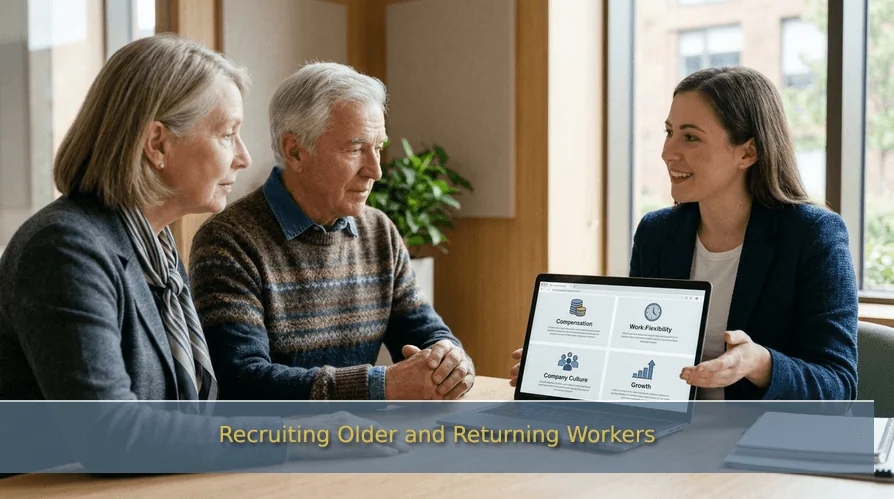
Many recruiting strategies overlook a growing pool. BLS reports that 19.1% of Americans 65 and older were in the labor force in 2025. Its 2025-2035 projections show the labor force aged 75 and older growing 68%, from 2.2 million to 3.7 million, and participation for ages 65-74 rising from 26.7% to 29.1%.
Many career pages quietly signal that experience is less desirable. Watch for phrases like “digital native,” photos that show only one age group, and caps on years of experience.
Returning workers, including retirees and caregivers coming back after a break, often want part-time, project-based, or phased roles. State that directly on the career page. Make the application easy to complete without a long online account setup, and offer a phone number or named contact.
Summary: Older and returning workers are a growing talent pool, and small wording and format changes can signal to them that they are welcome.
FAQs About How to Recruit Across Generations
1. Should we create a different career page for each generation?
No. Separate pages tend to stereotype candidates and are hard to keep current. A better approach is one page with clear sections that answer the questions different cohorts ask first like pay, flexibility, growth, stability, and culture. Candidates can then find what matters to them without being sorted by age. Building that kind of page is part of what we cover in multi-generational HR training.
2. How is recruiting across generations different from cross-generational marketing?
The principles overlap more than most teams expect. Both start with understanding how each cohort’s formative years shape what it trusts and how it searches. Recruiting adds a higher-stakes decision and a longer relationship, so honesty matters even more than polish. An employer brand that overpromises shows up later as early turnover. Many HR teams borrow tools directly from cross-generational marketing.
3. Do we really need to post pay ranges?
Some states require it, and candidates increasingly expect it everywhere. According to Indeed.com, 59% of US job postings included pay as of May 2025, so leaving it out makes you stand out for the wrong reason. Younger candidates facing cost of living pressure often skip posts without pay. Experienced candidates use ranges to judge whether the role matches their level. A realistic range saves time for everyone.
4. How do we keep new hires once recruiting works?
The promises on your career page have to match the first weeks on the job. If you advertised flexibility, mentoring, or growth, new hires will look for proof right away. A structured onboarding plan with clear expectations and a named buddy helps every generation settle in. Our post on revamping onboarding for the next generation walks through practical steps. Recruiting and onboarding work best when the same team designs both.
5. Does generational recruiting look different by industry?
The principles hold, but the details shift with each talent pipeline. Industries experiencing a wave of retirements need to speak to younger candidates and to experienced workers who could stay longer. Financial services is a clear example, as we explore in recruiting next-gen financial advisors. The right balance depends on your workforce data and your hiring goals. For a tailored plan, generational consulting can audit your career page, job posts, and process together.
