




Moving Past Millennial Fatigue as a Leader: Millennial fatigue is exhaustion with the conversation about Millennials, and it runs in both directions. Leaders who manage Millennials are tired of advice built on stereotypes that stopped being accurate years ago. Millennial leaders are tired of managing while carrying a narrative about their own generation. Both versions have the same root: a set of assumptions formed when this generation was in its twenties, still being applied to people who are now between 30 and 45 and hold the largest share of management roles in the country.
Key Takeaway
Millennial fatigue is exhaustion with the conversation about Millennials, and it runs in both directions. Leaders are tired of advice built on stereotypes that stopped being accurate years ago. Millennial leaders are tired of managing while carrying a narrative about their own generation. Both versions share one root: assumptions formed when this group was in its twenties, still applied to people who are now between 30 and 45 and hold the largest share of management roles in the country.
- The demographic reality behind the fatigue, and why early-career advice now actively backfires
- How Millennial job changing actually compared with Gen X, and why the reputation stuck anyway
- Why the pressing problem for Millennial managers is load and training rather than motivation
The fatigue is not a sign the conversation ran too long, it is a sign it stopped being updated.
The Narrative Stopped Matching the People

Most widely circulated claims about Millennials at work were formed between roughly 2010 and 2015, when the oldest members of the generation were around thirty and the youngest were still in school. Entitlement, job hopping, participation trophies, and a supposed allergy to feedback all date from that window.
The demographics have moved on entirely. Millennials are now 30 to 45. They are the largest generational cohort in the labor force at roughly 36%, and as of mid-2025 they hold the largest share of managerial roles.
Applying early-career management advice to a 42-year-old running a department does not just fail to help. It signals that you have not looked at who is actually in front of you, which is a credibility cost few leaders intend to pay.
Summary: The stereotypes describe a cohort in its twenties, and that cohort no longer exists.
The Job-Hopping Claim Never Held Up

The most persistent piece of the narrative is that Millennials will not stay anywhere. Pew analysis found that roughly 63% of Millennial workers had been with their employer thirteen months or more, against about 60% of Gen X workers at a comparable point. Around 22% of both groups reported five years or more.
In other words, the mobility difference that launched a decade of retention programming was largely not there. What differed was the economic environment, and the willingness to talk about moving openly.
The current environment has shifted again. Quit rates have fallen well below their 2022 peak and a substantial share of workers are staying put out of caution. Retention metrics that look strong right now may be measuring the labor market rather than your culture.
Summary: Millennial mobility was always closer to Gen X mobility than the reputation suggested.
What Millennial Managers Are Actually Carrying
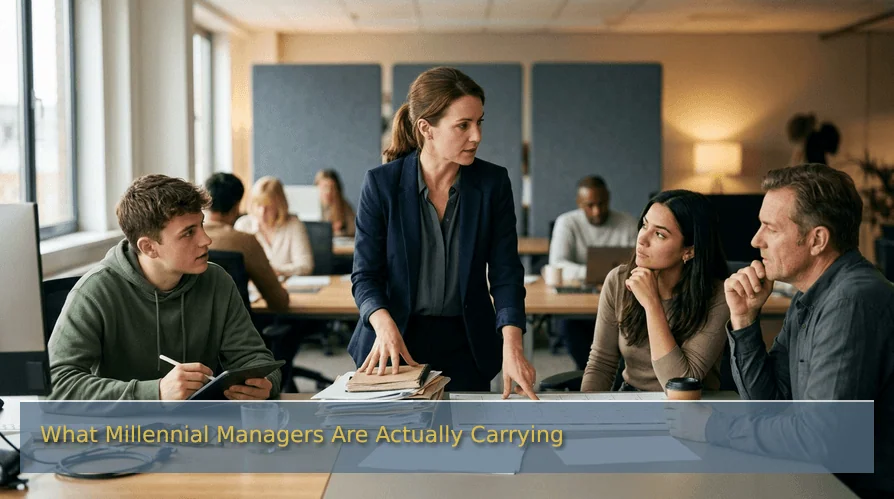
The more pressing issue in millennial management is not motivation, it is load. This group moved into leadership as management layers thinned, and the average number of direct reports per manager has risen sharply in recent years.
Support has not kept pace. Roughly 69% of Millennials report insufficient leadership development opportunities, and they are underrepresented among participants in the development programs that exist. Many are managing teams having never been taught how, which is a structural failure rather than a generational shortcoming.
They are also aging into caregiving responsibilities on both sides, the position Gen X occupied a decade ago. Peak career pressure and peak personal pressure are arriving simultaneously.
Summary: Millennial managers are under-trained and over-extended, and neither problem is fixed by better motivation.
Leading Without the Narrative

For leaders managing Millennials, the practical move is to stop treating generational commentary as a substitute for knowing your team. Ask what someone needs, then act on the answer. That works regardless of birth year.
For Millennial leaders, the version of fatigue that shows up internally is subtler: hesitating before asking for flexibility to avoid confirming a stereotype, or overworking to prove you are not what people assume. Leading in reaction to a narrative is exhausting in a way that leading from your actual strengths is not.
In both cases, the correction is the same. Separate what you have observed from what you have absorbed, and lead from the first one.
Summary: Lead from what you can observe about the person, not from what you have absorbed about the cohort.
FAQs About Millennial Fatigue
1. What is millennial fatigue?
It describes exhaustion with the ongoing public conversation about the Millennial generation rather than exhaustion from working with Millennials themselves. It appears in two forms. Leaders experience it as weariness with advice built on stereotypes that no longer describe the people they manage. Millennials experience it as the strain of working under a narrative about their own generation, which can quietly shape how much flexibility they ask for and how hard they push themselves to disprove assumptions. The antidote is not avoiding the topic but applying generational intelligence to it.
2. Do Millennials really change jobs more than other generations?
Not by the margin the reputation implies. Pew analysis found roughly 63% of Millennial workers had been with their current employer for thirteen months or more, compared with about 60% of Gen X workers at a similar career point, and roughly 22% of both groups reported five years or more. The perception of high mobility owed more to the economic conditions of the 2010s and to how openly the generation discussed job changes than to genuinely different behavior.
3. Why do Millennial managers report feeling unprepared?
Because most were promoted without formal preparation. Around 69% report a lack of leadership development opportunities, and they are underrepresented in the programs that do exist. At the same time, management layers have thinned and the average number of direct reports per manager has increased substantially. The combination produces managers with wider spans of control, less training, and higher stakes than the generation that preceded them had at the equivalent stage. It is the gap a millennial speaker is most often booked to address.
4. How should organizations support Millennial managers?
Start with actual training rather than resources. Formal management development has strong evidence behind it and remains unavailable to a large share of people currently managing teams. Beyond that, examine spans of control honestly, since no amount of training compensates for too many direct reports. Finally, recognize that this group is entering the caregiving stage that Gen X occupied a decade ago, and that flexibility policies designed for early-career employees will not fit their circumstances. Most of that support is practical rather than motivational, and it is what training millennials in the workplace is designed to deliver.
5. Will the same thing happen to Gen Z?
It already is. The commentary now forming about Gen Z closely resembles what was said about Millennials fifteen years ago, using similar language about entitlement, work ethic, and feedback expectations. The pattern is durable enough to be predictable: each generation entering the workforce is characterized through the lens of the one already established there. Recognizing the cycle is the most reliable protection against repeating it, which is a useful thing for Millennial managers in particular to notice.
