

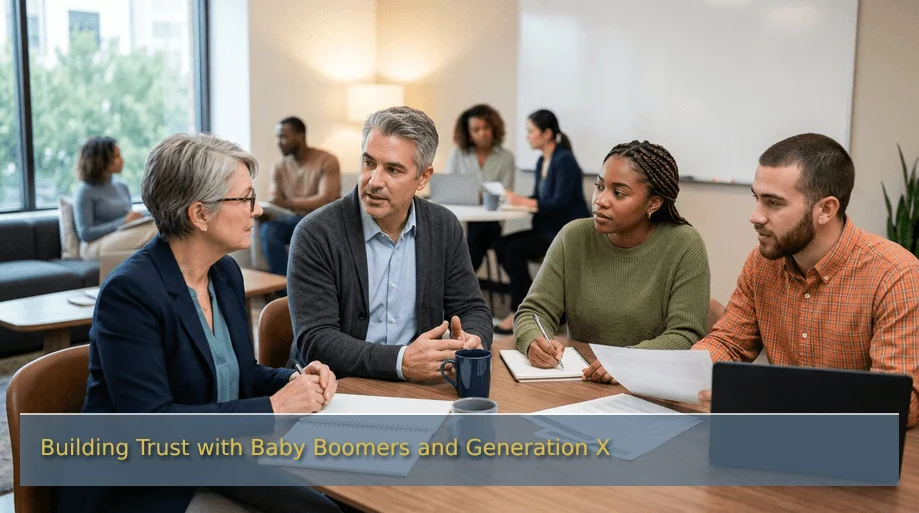
Building Trust with Baby Boomers and Generation X: Baby Boomers and Gen Xers both want leaders they can trust, but they read trust through different signals. Boomers tend to extend trust to leaders who demonstrate credibility, offer a clear plan, and take a genuine personal interest in them. Gen Xers tend to extend trust to leaders who are honest about what they do not yet know, respect their time, and then step back once expectations are set. If you lead both, the move is not to choose between those styles. It is to name the plan clearly enough for your Boomers and admit the uncertainty honestly enough for your Xers, in the same conversation.
Key Takeaway
Trust is not a personality trait that leaders either have or lack. It is a set of signals, and Boomers and Gen Xers learned to read different ones during their formative years. Boomers look for demonstrated credibility and genuine personal investment. Xers look for candor about what is still uncertain and the autonomy to get on with the work. The useful news for anyone leading both is that a single message can carry both signals at once.
- Why Boomers start closer to trust and Xers start closer to caution, and what each is waiting to see
- Two specific levers per generation: credibility and connection for Boomers, candor and autonomy for Xers
- One communication approach that serves both, rather than two you have to switch between
Two generations, one set of institutions, and two entirely reasonable conclusions about how far to trust them.
1. Why Trust Reads Differently Across Generations
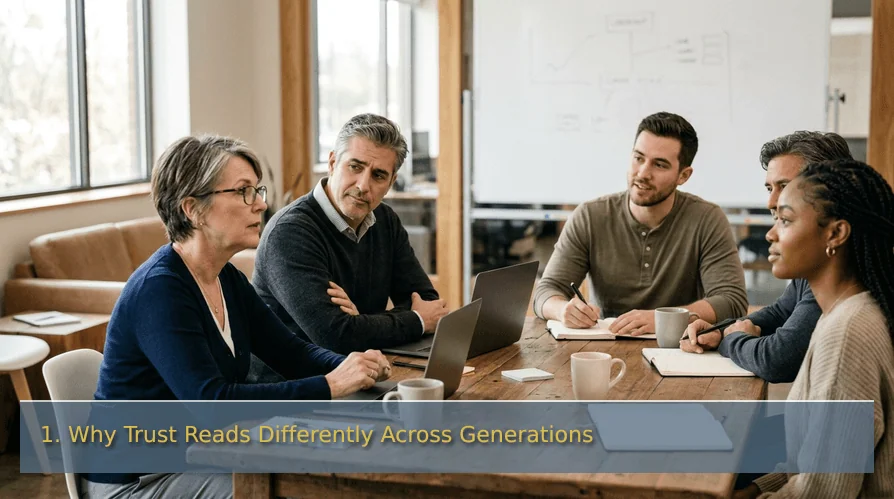
Boomers, born between 1946 and 1964, came of age when major institutions still spoke with a single authoritative voice. A trusted figure delivered the news, explained what it meant, and closed the segment. That does not mean Boomers are naive. It means their default starting position is closer to trust, and what sustains it is competence plainly demonstrated.
Gen Xers, born between 1965 and 1980, came of age watching those same institutions get caught out. Cable news arrived, the scandal cycle accelerated, and the curtain came down on more than one trusted name. Their default starting position is closer to verify first, and what sustains it is being told the truth early, including the unflattering parts.
Neither position is cynicism or credulity. Both are reasonable conclusions drawn from what each group actually watched happen. This is the “why behind the what” at the center of how we look at generational patterns: the behavior only makes sense once you know the vantage point that produced it.
Summary: Boomers start closer to trust and want it confirmed. Xers start closer to caution and want it earned.
2. Baby Boomers: Credibility and Personal Connection
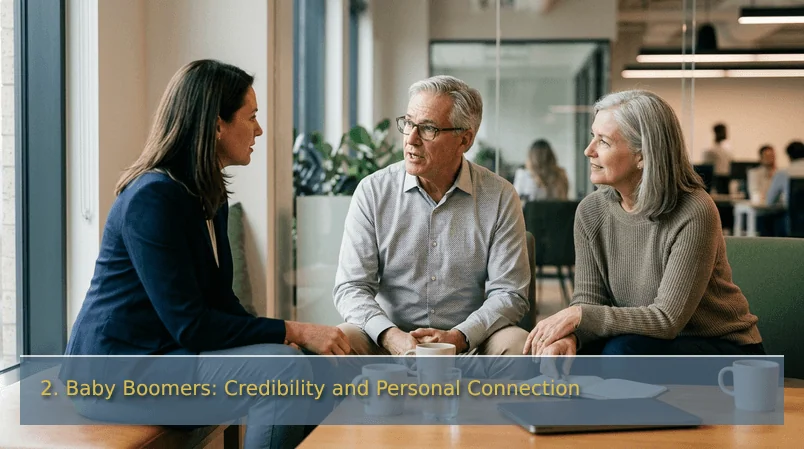
Boomers now make up roughly 15% of the US labor force, a share that has fallen sharply as retirements accelerate. The ones still working are often the most institutionally knowledgeable people you have, and many are working longer than they planned because market volatility and rising healthcare costs reshaped their timelines.
Building Baby Boomer workplace trust usually comes down to two things. The first is demonstrated credibility: show that you have thought the problem through, name the plan, and be specific about what happens next. Vague reassurance reads as evasion. The second is personal connection. With this group, small talk is not small. A check-in that asks how someone is actually doing, and then waits for the answer, does more for trust than three all-hands slides.
This holds outside your own walls too. If your client base skews older, the same instincts apply, and the relationship maintenance that feels optional to a younger manager is often the entire reason the account renews.
Summary: With Boomers, name the plan clearly and invest in the relationship, because credibility and connection travel together.
3. Generation X: Transparency and Efficiency
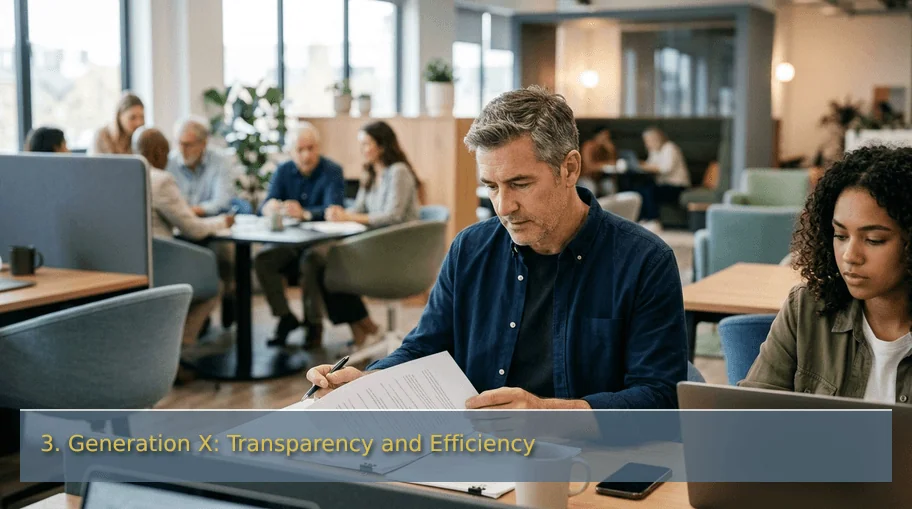
Gen X now holds roughly 31% of the US labor force and sits in a genuinely difficult position: senior enough to absorb the hardest problems, and simultaneously caring for children and aging parents. The sandwich pressure is real, and it shows up at work as a very low tolerance for anything that wastes time.
Transparency is the lever here. Say what you know, say what you do not know, and say when you expect to know more. Xers have a well-calibrated sense for optimism used as a substitute for information, and a leader who overstates certainty loses standing that is hard to recover. Delivering hard news straight, without softening it into meaninglessness, is a trust deposit rather than a withdrawal.
Efficiency is the second lever. Position yourself as a resource that is available rather than a presence that is required. Once expectations are clear, the fastest way to signal trust to an Xer is to stop checking.
Summary: With Xers, trade certainty for candor and oversight for autonomy, and the skepticism eases on its own.
4. Leading Both at Once

Most leaders do not get to run two separate communication strategies, and they should not try. The good news is that the two sets of needs are compatible more often than they look. A message that opens with the plan and the reasoning satisfies the Boomer need for credibility. The same message, if it names the open questions honestly rather than papering over them, satisfies the Xer need for transparency.
What breaks is the shortcut version. An all-clear with no detail reads as unprepared to a Boomer and as spin to an Xer. Both conclusions cost you.
The individual variation here is real, and plenty of Boomers are skeptics while plenty of Xers take leaders at their word. The generational lens is useful for noticing patterns and asking better questions, not for deciding in advance who someone is.
Summary: One message can serve both groups when it pairs a clear plan with an honest account of what is still unknown. Leaders who want this framed for a whole team often open with a generational keynote speaker, so everyone shares the same language before the harder conversations start.
FAQs About Building Trust with Baby Boomers and Generation X
1. How is trust in leadership actually measured?
Most workplace research measures trust through agreement statements rather than a single question, asking whether employees strongly agree that leadership communicates clearly, acts on stated values, and makes them feel optimistic about the future. As of 2025, roughly one in three employees globally strongly agrees they trust their organization’s leadership, and that figure has stayed stubbornly flat for several years. The measure matters because trust correlates closely with engagement, and engagement correlates with productivity, retention, and discretionary effort.
2. Are Gen Xers really more skeptical, or is that a stereotype?
The pattern shows up consistently enough in workplace research to be useful, but it is a tendency rather than a rule. Gen X came of age during a period of visible institutional failure and rapid media expansion, which reasonably shaped a verify-first instinct. What matters practically is that the skepticism is directed at claims, not at people. Xers are not withholding trust as a personality quirk. They are waiting for evidence, and they extend trust readily once transparency has been demonstrated a few times.
3. Why are so many Baby Boomers still working?
Several pressures converged. Market volatility disrupted retirement timelines, healthcare costs continued rising faster than general inflation, and longer life expectancy stretched how far savings need to go. A significant share of Boomers approaching or past traditional retirement age report postponing their plans for financial reasons. There is also a non-financial factor that organizations underweight: many Boomers find identity and purpose in their work and are not eager to give that up, particularly where phased or flexible arrangements are available.
4. What is the fastest way to lose trust with either generation?
Overpromising. With Boomers, a commitment made and then quietly dropped undermines the credibility that trust rests on, and the damage is disproportionate to the size of the broken promise. With Xers, optimism that turns out to have been unfounded confirms the suspicion they started with, and they will discount your next several communications accordingly. In both cases, the recovery cost is far higher than the cost of having said “I do not know yet” in the first place. Avoiding that trap is the core discipline of cross generational management: set the expectation once, in the open, then hold to it.
5. Does remote work make cross-generational trust harder?
It removes the incidental contact that used to build trust without anyone planning it, which affects the two groups differently. Boomers lose the informal conversation that signals personal interest, so deliberate check-ins matter more. Xers generally adapt well, since distributed work delivers the autonomy they value, but they can drift out of visibility in ways that hurt them at promotion time. The fix is the same for both: make the connection intentional rather than assuming proximity will handle it. Remote and hybrid settings strip out the informal cues that build trust, which is why deliberate cross generational communication habits matter more when a team rarely shares a room.
