




Early Millennials and Recessionists: Meet The Two Millennial Subgroups: Millennials are routinely discussed as one group, and our research points to two distinct subgroups within the cohort. Early Millennials, born roughly 1981 to 1987, came of age alongside technology as it emerged and entered the workforce before the financial crisis. Recessionists, born roughly 1988 to 1996, came of age with technology already integrated and entered adulthood during or immediately after the Great Recession. The split explains why Millennials can appear to contradict themselves at work, and why a single engagement strategy aimed at the whole generation so often misses.
Key Takeaway
The split is driven by timing rather than temperament: when technology, economic security, and cultural events arrived during someone’s formative years. Early Millennials grew up alongside technology as it emerged and entered the workforce before the crash. Recessionists grew up with it already integrated and entered adulthood during the downturn. That difference is why one engagement strategy aimed at the whole generation so reliably satisfies half of it and puzzles the other half.
- Why a fifteen-year birth span produced two recognizably different groups
- How each subgroup responds to new technology, and why they want opposite things from a rollout
- Where the retention signals diverge, since what disengages each group is different
One generation, two formative windows, and a set of differences that only look like contradictions from the outside.
Why Millennials Split in the First Place

Three forces separate the two subgroups: technology, security, and the economy. Each arrived at a different point in each group’s formative years, and formative timing is what shapes expectations that persist for decades.
The generation spans birth years 1981 to 1996, which is a wide window. Someone born in 1982 was already working when the financial crisis hit. Someone born in 1994 was still in school. Those two people watched the same event from entirely different positions, and drew different conclusions about how much stability to expect from an employer.
This is the mechanism behind most millennial characteristics that appear inconsistent. They are not inconsistent. They belong to two different cohorts sharing one label.
Summary: Timing, not temperament, is what divides this generation into two recognizable groups.
Early Millennials: Teens of the Nineties

Early Millennials grew up alongside technology rather than inside it. Technology existed but had limits, and the limits mattered. A phone was not a smartphone. Photos, music, and messages lived on separate devices. Getting online meant occupying the household phone line, so use was intentional, scheduled, and shared.
Social platforms existed without algorithms shaping behavior or delivering constant feedback. The like button did not arrive until adulthood, meaning this group spent its formative years expressing itself without real-time validation attached.
The result is a cohort that treats technology as a tool: valuable when it improves communication and outcomes, dispensable when it does not. In a rollout, Early Millennials want thoughtful implementation, proper training, and shared buy-in before anything changes.
Summary: Early Millennials evaluate new technology on whether it earns its place, and want to be consulted before it arrives.
Recessionists: Teens of the 2000s
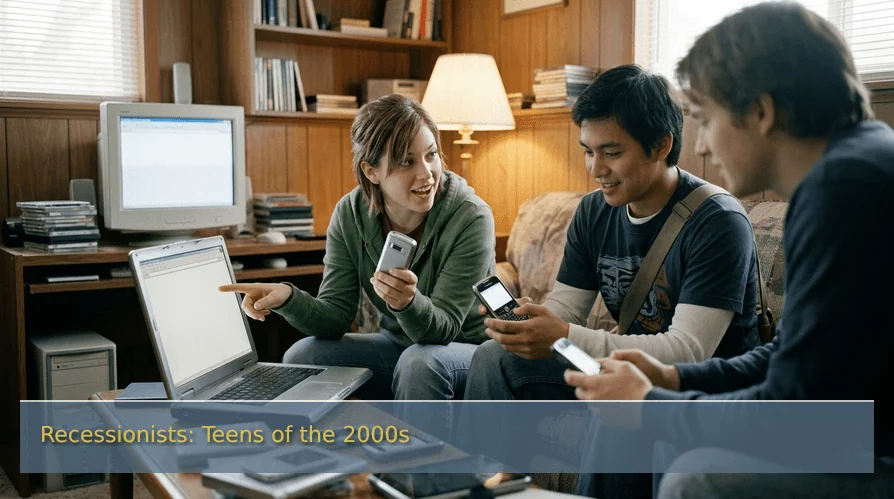
Recessionists did not grow up in today’s algorithm-driven, always-connected environment. That distinction belongs to Gen Z. But they did come of age as technology became integrated, faster, and expected. Personal devices were common by adolescence, connectivity was reliable, and upgrades were assumed rather than occasional.
They are consequently less attached to particular systems and more focused on whether a tool delivers. Rather than asking whether new technology should be adopted, they are more likely to ask why it has not been already.
Economically, this group entered college or the workforce during or just after the Great Recession. Job scarcity, rising student debt, and visible financial instability produced a more security-focused worldview. For many, success is tied closely to stability, compensation, and long-term viability rather than to title.
Summary: Recessionists expect continuous improvement and weight financial security heavily, having watched what happens when it disappears.
Why This Matters at Work

The practical divergence shows up during change. In a technology rollout, Early Millennials prioritize alignment, training, and team input. Recessionists are more likely to ask why the organization is not already using the better tool. Both want a good outcome. They disagree about how change should happen.
Retention signals differ too. A common leadership blind spot is investing in culture and engagement programming while leaving pay transparency, workload sustainability, and advancement paths unaddressed. Early Millennials may respond well to cultural investment. Recessionists are more likely to disengage when structural and financial security feels uncertain, and roughly 46% of Millennials report not feeling financially secure.
As always, individual variation is real. These are patterns worth testing against the person in front of you, not conclusions to apply in advance.
Summary: One engagement strategy across a fifteen-year span will reliably satisfy half the generation and puzzle the other half.
Frequently Asked Questions About Millennial Subgroups
1. What years define the Millennial generation?
Millennials were born between 1981 and 1996, making them 30 to 45 years old in 2026. Some frameworks extend the range slightly, and boundary years are always somewhat arbitrary because generations are shaped by shared experience rather than by a clean calendar break. What makes this particular cohort unusual is the width of the formative window relative to how much changed inside it. The technological and economic conditions of 1990 and 2005 were different enough to produce two recognizable subgroups.
2. Are Millennial subgroups a widely accepted idea?
Subdividing large cohorts is increasingly common in generational research, though the specific labels vary between organizations. The underlying logic is well established: when a generation spans fifteen or more birth years during a period of rapid change, the oldest and youngest members had materially different formative experiences. Similar splits are applied to Baby Boomers, who are frequently divided into early Boomers and a younger group whose formative years came after the major cultural upheavals of the 1960s.
3. Which subgroup is in leadership now?
Predominantly Early Millennials, who are now in their late thirties and forties, though Recessionists are moving into management steadily. Millennials as a whole became the largest share of US managers in mid-2025. The composition matters because the two subgroups tend to lead differently. Early Millennials generally emphasize consensus and buy-in before change, while Recessionists more often push for speed and measurable improvement, which can read as impatience to colleagues who prefer the former. It is the distinction a millennial speaker draws first, because the two subgroups manage very differently.
4. How does the Great Recession still affect Recessionists today?
Primarily through risk calibration. Entering the labor market during a downturn is well documented as having durable effects on earnings, job mobility, and attitudes toward employer stability, and those effects persist long after conditions improve. In practice, this shows up as heavier weighting of compensation and job security relative to less tangible benefits, more scrutiny of an employer’s financial health, and less willingness to accept promises about future advancement without something concrete attached.
5. Should we design separate programs for each subgroup?
Rarely, and usually not worth the administrative overhead. The more practical application is in how change and communication are handled. When introducing new technology or process, build in both the consultation Early Millennials expect and the clear rationale for speed that Recessionists want, since those requirements are compatible. For engagement, the distinction is most useful as a diagnostic. If a program is landing unevenly across your Millennial population, this split is a reasonable place to look first. One programme is usually enough, provided training millennials in the workplace allows for the different economic starting points of each subgroup.
