

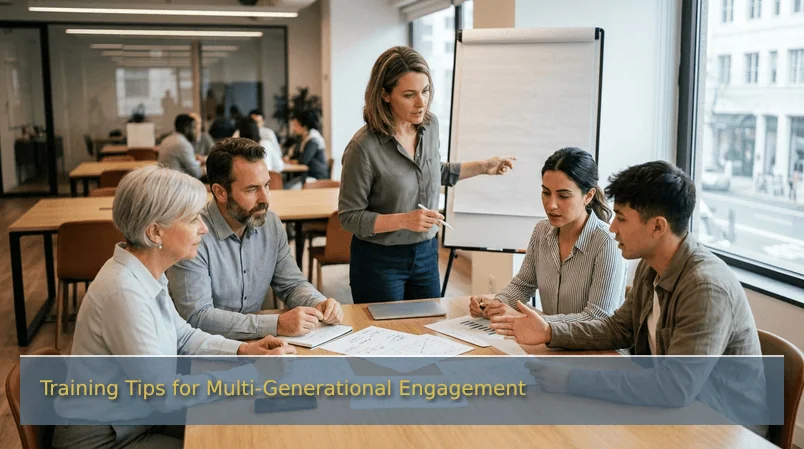
Training Tips for Multi-Generational Engagement: Getting a four-generation room to stay with you comes down to three things: establish credibility in the opening minutes, choose in-person delivery when the material actually matters, and make the relevance explicit rather than assuming people will find it. The common failure is not that attention spans have collapsed. It is that most corporate training asks a Boomer, an Xer, a Millennial, and a Gen Zer to care about the same thing for the same reason, and gives none of them a reason that fits.
Key Takeaway
People are perfectly capable of sustained attention. They are selective about what earns it. A session that opens without establishing why the trainer is worth listening to, and never connects the material to the work anyone actually does, loses the room for entirely rational reasons. Three decisions determine whether it holds: how you open, where you deliver, and how explicitly you state the relevance.
- What each generation is evaluating during the first five minutes, and how to satisfy all four
- A clear rule for when virtual delivery is sufficient and when in-person is worth the cost
- Language for making relevance explicit, rather than assuming participants will find it themselves
Four generations, one room, and four different answers to the question of why this matters.
Start Strong and Establish Credibility

The opening minutes decide more than most trainers expect, and different generations are evaluating different things during them.
Boomers are assessing authority: what qualifies you to be at the front of this room. State it plainly rather than waiting to be asked. Gen X is running a faster and more skeptical version of the same calculation, and appreciates the credentials stated once, without a lengthy preamble. Millennials and Gen Z are largely assessing whether the next ninety minutes will be participatory or performed at them.
A short, low-stakes interactive element early does useful work across all four groups. It taps competitiveness, creates the collaboration Millennials tend to want, and, if it is genuinely brief, respects the efficiency that Gen X and Gen Z both prize.
Summary: Earn the room in the first five minutes, because you will not get a second opportunity.
Choose In-Person When the Material Matters

Virtual delivery scales, and for compliance content or straightforward information transfer that is often the right call. For anything requiring behavior change, in-person still outperforms it substantially.
The reasons are generational as much as pedagogical. In-person gives Millennials the peer connection that makes learning stick. It gives Boomers relief from screen fatigue and a chance for the direct conversation they prefer. And it gives Xers something they will not say out loud: permission to focus on one thing without a queue of notifications competing for the same attention.
Gen Z is the group most often assumed to prefer digital delivery, and that assumption is frequently wrong. Having spent formative school years learning remotely, many actively prefer face to face. When planning Gen Z corporate events or in-person sessions, the demand is usually higher than expected.
Summary: Use virtual for information and in-person for anything you need people to actually do differently.
Make the Relevance Explicit

The single most common failure in multi-generational training is assuming participants will connect the material to their own work. Most will not, and the ones who do will connect it to different things.
Say why the session exists in concrete terms: what problem it addresses, what it prevents, what changes if people apply it. Gen X wants that stated early and without decoration. Millennials want the connection to broader impact and to their own role in it. Gen Z wants direct applicability to the work in front of them this quarter. Boomers want to know it fits the organizational direction they have helped build.
Frontline stories do more work here than frameworks. A specific example of the problem occurring, and what it cost, is more persuasive to every generation in the room than a model explaining why it might.
Summary: Relevance stated beats relevance implied, every time and for every generation.
Build for Skills, Not Just Awareness

As of 2026, skill-building ranks among the highest priorities for both Gen Z and Millennials, who together represent the majority of most training audiences. They are already pursuing development independently, frequently using AI tools to fill gaps their employers have not addressed.
That is an opportunity rather than a threat. Training positioned as capability-building rather than compliance draws a fundamentally different level of engagement, and it addresses retention at the same time.
It also reframes the older generations in the room. Boomers and Xers hold institutional knowledge that no external program can supply, and structuring sessions so that knowledge moves in both directions turns a training event into something closer to reverse mentoring.
Summary: Position training as capability rather than compliance, and attendance stops being the problem you are solving.
FAQs About Training Tips for Multi-Generational Engagement
1. Have attention spans really dropped to eight seconds?
No. That figure circulated widely for years but has no research basis. Investigations traced it to a data aggregator that could not substantiate it, and the corporate report most often credited with the claim never actually contained it, nor the goldfish comparison attached to it. Attention has become more selective rather than shorter, which is a meaningfully different problem. People still sustain focus for hours on content that earns it. Designing training around a debunked number produces the wrong solutions.
2. How long should a multi-generational training session run?
Structure matters more than total duration. Sessions running ninety minutes to half a day work well when broken into segments of roughly twenty to thirty minutes with genuine changes of mode between them, moving from presentation to discussion to application. Full-day sessions can succeed but require deliberate variation and real breaks. The failure pattern is not length itself, it is uninterrupted single-mode delivery, which loses every generation in the room at roughly the same rate. Most multigenerational workforce training lands better in 90-minute blocks with practice built in than in one long session.
3. Should training be separated by generation?
Rarely, and usually not. Separating groups removes the exact interaction that makes generational training valuable, which is people hearing directly why a colleague operates differently. It also risks reinforcing the stereotypes the session is meant to reduce. The exception is leadership-specific content, where separating by management level rather than by generation can be useful. Mixed-generation rooms consistently produce better conversation, provided the facilitator can hold the discussion without letting it become adversarial. Keeping the room mixed is usually the point: training different generations in the workplace works because people hear each other’s reasoning first-hand.
4. How do you handle participants who are openly skeptical of generational content?
Take the objection seriously and address it in the opening. The most common version is that generational framing amounts to stereotyping, which is a fair concern and worth answering directly: the goal is to identify patterns shaped by shared formative experience, not to predict individual behavior. Naming the limits of the framework early builds credibility with skeptics, who are frequently Gen X. Skepticism that goes unacknowledged tends to harden. Skepticism that gets a direct answer often converts.
5. What is the best way to measure whether the training worked?
Satisfaction scores collected immediately after a session measure enjoyment rather than effect. More useful indicators include behavior change observed thirty to ninety days later, changes in the specific friction the training targeted, and manager reports on whether the vocabulary is being used in practice. For generational content specifically, a strong signal is whether cross-generational conversations that previously did not happen are now happening without a facilitator in the room.
