

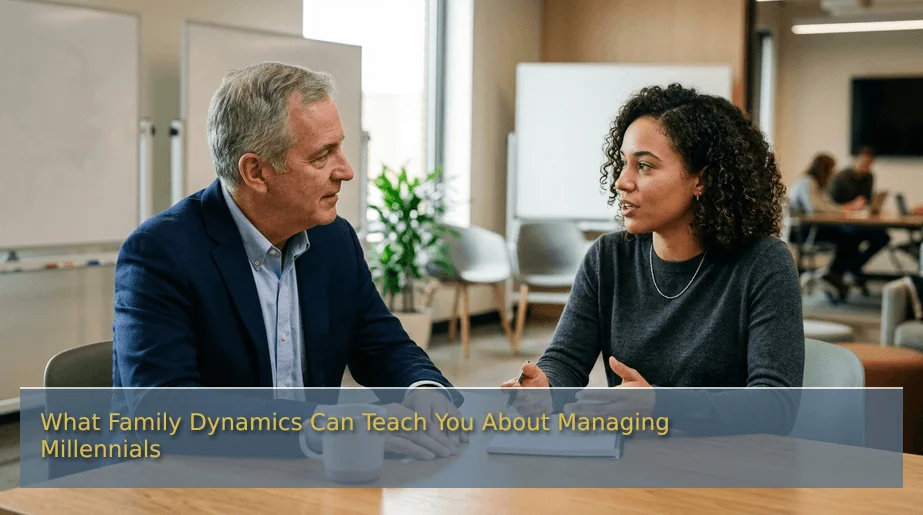
What Family Dynamics Can Teach You About Managing Millennials: Managing Millennials tends to feel less like a technical problem and more like a relational one, which is why a family analogy is useful. Boomers managing Millennials often falls into a parent-like dynamic built on mentorship. Gen X managing Millennials behaves more like siblings, balancing skepticism against optimism. Millennials managing Millennials is peer-like, easy at first and complicated around authority. And Gen Z managing Millennials, which is now happening, inverts the whole thing. The analogy is a lens for noticing patterns, not a system for labeling people.
Key Takeaway
Every leader brings a generational lens into how they mentor, communicate, and set expectations, usually without noticing it. Cast as family roles, the four dynamics become recognizable immediately: Boomers managing Millennials behaves like a parent, Gen X like a sibling, Millennials like a peer, and Gen Z like the younger sibling who ended up in charge. Millennials in the workplace became the largest share of US managers in mid-2025, so most organizations are now running all four at once.
- Less friction in reporting relationships, because the mismatch gets named rather than just felt
- Better mentorship, since the exchange is structured to run both ways rather than downward
- Clearer authority in peer-aged and age-inverted reporting lines, where managers struggle most quietly
Four dynamics, one family table, and a fair amount of tension that makes sense once you can see the seating chart.
Boomers Managing Millennials: The Parent-Like Dynamic
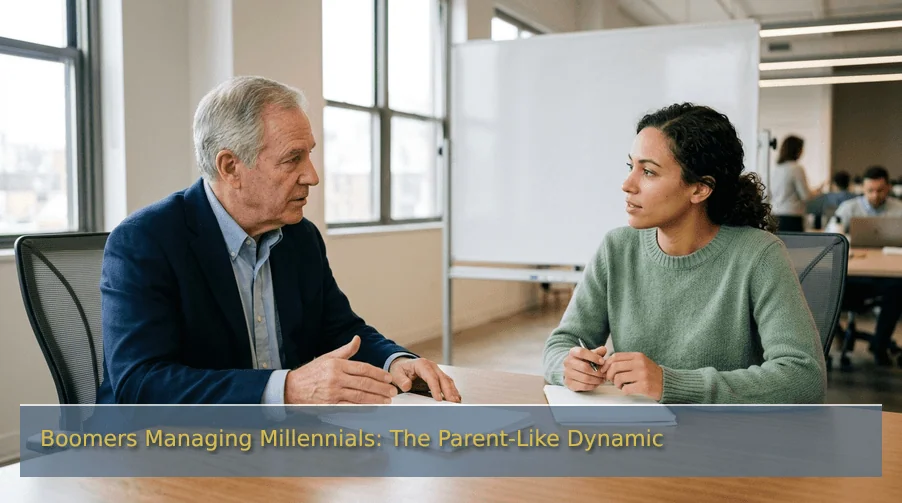
This pairing often works well because mentorship comes naturally to it. Boomer leaders bring experience, long-term perspective, and a genuine investment in developing the people behind them. Millennials generally welcome that investment.
Tension surfaces around what readiness means. Boomers frequently associate it with tenure and time served, having advanced through organizations where that was the actual mechanism. Millennials tend to associate it with demonstrated capability and momentum. Neither definition is wrong, and when neither is spoken aloud, both parties conclude the other is being unreasonable.
The fix is unglamorous: say what readiness requires in this organization, specifically, and revisit it. Ambiguity here is what turns a good developmental relationship into a frustrating one.
Summary: This dynamic works best when mentorship is a shared exchange rather than a one-directional transfer of wisdom.
Gen X Managing Millennials: The Sibling-Like Dynamic
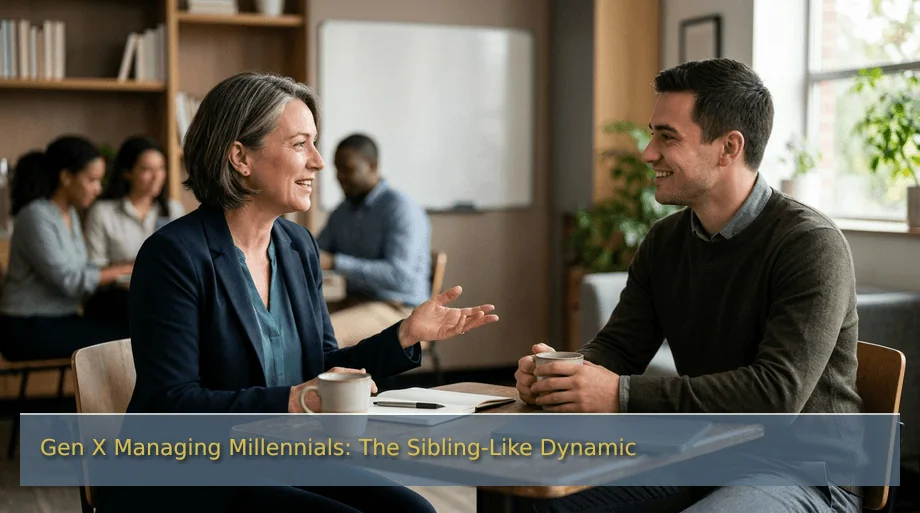
These two generations often balance one another usefully. Gen X skepticism grounds Millennial optimism, and both value efficiency and straight talk, even though they express those preferences differently.
The friction is almost always about communication frequency. Millennials generally want regular feedback and confirmation they are on track. Gen X managers, shaped by early self-reliance, tend to read frequent check-ins as a signal that someone needs supervision. One side feels micromanaged or ignored, the other feels crowded or abandoned, and neither is describing the same situation.
This is worth naming directly in a first one-on-one rather than discovering it six months later.
Summary: Agreeing on communication cadence resolves most of this without either person changing their natural style.
Millennials Managing Millennials: The Peer-Like Dynamic
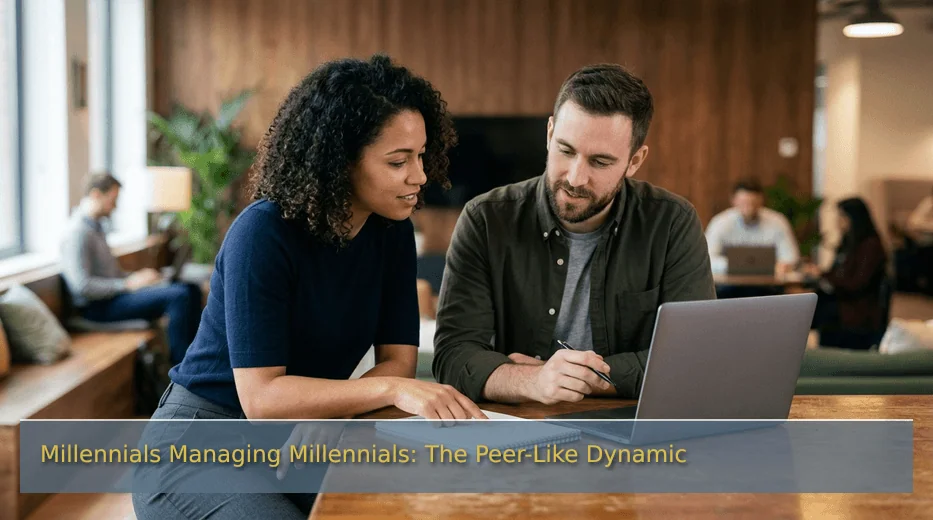
Shared reference points make this feel effortless early on. Communication styles align, trust builds quickly, and cultural expectations largely match.
The difficulty arrives with authority. Managing people who feel like equals makes accountability conversations uncomfortable, and many Millennial managers postpone them. Compounding this, roughly 69% of Millennials report a lack of leadership development opportunities, and they make up a disproportionately small share of leadership development participants. Many are managing without ever having been taught how.
The average number of direct reports per manager has also risen sharply in recent years, which turns a discomfort with hard conversations into a genuine capacity problem.
Summary: Closeness is an asset until accountability is required, at which point clarity has to do the work that rapport cannot.
Gen Z Managing Millennials: The Inverted Dynamic
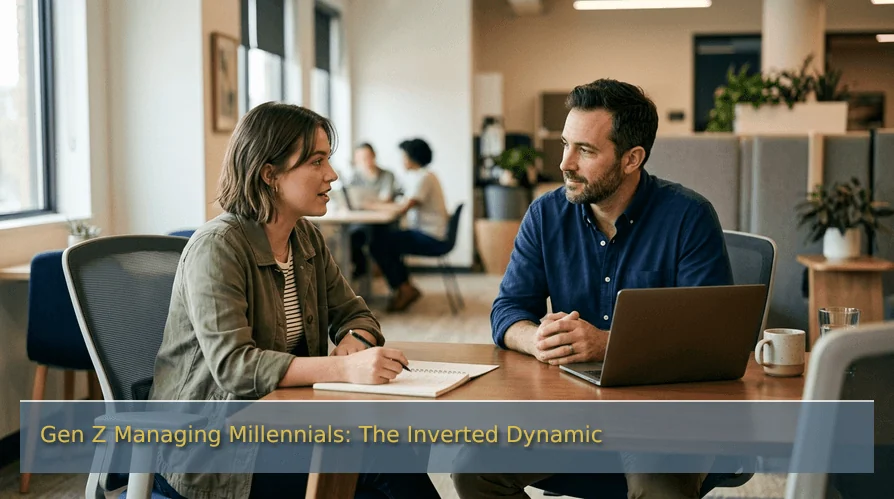
This is the dynamic the original family analogy missed, and it is no longer hypothetical. Gen Z now accounts for roughly one in ten managers, and that share is climbing as Boomers exit.
Age-inverted reporting lines create discomfort in both directions. A Gen Z manager may hesitate to give developmental feedback to someone ten years their senior. A Millennial direct report may bristle at direction from someone they read as earlier in their career, even while intellectually rejecting that reaction.
What resolves it is the same thing that resolves the other three: making the reasoning visible. Authority attached to a role rather than to age is easier to accept when the expectations are explicit and the competence is demonstrated rather than asserted.
Summary: Age-inverted management works when authority rests on clarity and demonstrated capability rather than on seniority.
FAQs About What Family Dynamics Can Teach You About Managing Millennials
1. How old are Millennials now?
Millennials were born between 1981 and 1996, placing them between 30 and 45 years old in 2026. That range matters because most management advice still in circulation about this generation was written when they were in their twenties. Applying guidance designed for early-career employees to a 42-year-old running a department reads as condescending and tends to damage credibility quickly. The demographic reality is that Millennials are now the core management layer of most organizations.
2. Are Millennials good managers?
The evidence is mixed and largely reflects preparation rather than aptitude. Millennial managers are consistently associated with greater emphasis on empathy, psychological safety, and boundary-setting, which correlate positively with team engagement. The counterweight is that many were promoted without formal leadership training, and a large majority report insufficient development support. The pattern suggests the instincts are sound and the scaffolding is missing, which is an organizational problem rather than a generational one.
3. Why is managing peers of the same age so difficult?
Because the relationship changes without the social dynamics changing with it. Peer-aged managers frequently built genuine friendships with people who now report to them, and the instinct to preserve those relationships makes accountability conversations feel like betrayals. The reliable solution is structural rather than emotional. Setting explicit expectations early, holding regular one-on-ones as a matter of routine, and separating performance discussions from social contact all reduce the load that rapport would otherwise have to carry. Managers hitting this for the first time often work through it in a leading multigenerational teams workshop.
4. Does the family analogy risk oversimplifying things?
It would, if it were used as a system rather than a lens. Families are not a perfect model for workplaces, and the analogy breaks down quickly if pushed past its usefulness, particularly around the idea that a manager occupies a parental role. What it does well is make an abstract dynamic recognizable. Most people can immediately identify the difference between being advised by a parent, a sibling, and a peer, and that recognition is the whole point.
5. What is the most common mistake in cross-generational management?
Assuming that what motivated you will motivate the person you manage. Leaders reliably default to the recognition, feedback cadence, and level of autonomy that worked for them at a similar stage, then interpret a flat response as a problem with the individual. The correction takes one conversation. Ask each direct report how they prefer to receive feedback, recognition, and support, and then act on what they tell you rather than on what you would have said in their position. Most of what goes wrong in cross-generational management starts with assuming a shared context that is not actually there.
